Showing posts with label design properties. Show all posts

Tuesday, 3 June 2025

Design Data for Engineers: Thermal Aging of PPS Compounds

Hello and welcome to today’s blog post on thermal aging of PPS compounds. During material selection, focus on gathering and understanding all the requirements of the application is essential. Key questions to answer are: What is the service environment of your part? And also: What types of load at which service temperature and time need to be fulfilled?

Thermal aging of Polyphenylene sulfide (PPS) compounds (glass; glass/mineral filled)

High performance polymers such as Polyphenylene sulfide (PPS) offer excellent performance during high heat exposure. PPS mouldings, both filled and unfilled, maintain inherent flame resistance and excellent chemical resistance due to the base resin.

Long-term heat aging results align with the polymer's thermal stability. PPS has a UL 746B continuous use temperature (CUT) of 220°C. It is in a similar range with PPSU which has a CUT of 210°C and PTFE is even above 230°C. 

Figure 1 highlights the good retention of tensile properties in glass and glass/mineral-filled compounds over long-term exposure. An aging test was performed at two temperatures (175°C and 230°C) for a maximum duration of 10,000 hours [2]. 

Figure 1: Thermal aging of PPS compounds (175°C and 230°C; 10,000 hours).

Due to the curing characteristics of cross-linked PPS, aging at temperatures above those in Figure 1 can enhance property retention, attributed to a "case hardening" effect from high-temperature air exposure.

At elevated temperatures, PPS compounds show classical deterioration beyond their glass transition temperature (Tg). Despite crystallinity effects, strength loss is gradual, with significant integrity retained even at 200°C. PPS compounds filled with glass and mineral can retain the tensile properties at both temperatures at a higher level (80% retention rate) compared to glass fiber reinforced PPS compounds (60% retention rate).

Generally, 40% glass-filled mouldings retain about 80% of their original strength at 100°C, 60% at 160°C, and 40% at 200°C.

Conclusion

In conclusion, Polyphenylene sulfide (PPS) compounds demonstrate exceptional performance under high heat exposure, making them a reliable choice for applications requiring thermal stability. Both filled and unfilled PPS moldings exhibit inherent flame resistance and chemical resistance, aligning with the polymer's robust thermal properties. The long-term heat aging results confirm PPS's ability to retain tensile properties, even at elevated temperatures. With a continuous use temperature of 220°C, PPS stands out among high-performance polymers, maintaining significant strength and integrity over time. This makes PPS an excellent candidate for applications demanding durability and reliability in challenging thermal environments. When selecting materials, it is crucial to thoroughly understand the application's requirements, including service environment, load types, and service temperatures, to ensure optimal performance and longevity.

Thanks for reading and #findoutaboutplastics

Greetings

Literature: 

[1] https://www.findoutaboutplastics.com/2024/09/high-performance-thermoplastic.html

[2] Don Brady: Polyphenylene sulfide (PPS), Phillips Petroleum Company


Wednesday, 25 October 2023

Design Properties for Polymer Engineers: Weather and UV Resistance of Commodity and Engineering polymers (styrene copolymers and PMMA)

Hello and welcome to this blog post on weather and UV resistant engineering polymers. I have split this post in three sections (overview styrene polymer family and PMMA; design data; material selection) and it should be supporting you in your next material selection project.

Short overview of the styrene polymers family (styrenics) and Polymethylmethacrylate (PMMA)

Polystyrene (PS) is widely known as material for packaging and consumer goods applications has a good hydrolysis behaviour, however has low performance when exposed to UV-light and weathering.  It is an amorphous polymer and is fully transparent. Anti-UV agents and/or carbon black needs to be added in case it is used for exterior applications. Next to PS we have Styrene-acrylonitrile copolymer (SAN). Main impact is the amount of acrylonitrile. It can bes used between -20°C and 85°C, short time exposure till 95°C. It is a transparent polymer however it has a slight yellow impression. Therefore, soluble blue color is added to overcome this yellow appearance turning it into a slight bluish material. Adding glass-fibers to SAN will result in an engineering polymer (high stiffness, low shrinkage in-flow and cross-flow). In comparison to PS, SAN has a better weatherability performance which increases with the acrylonitrile amount. Downside is the rapid water uptake due to the polar nitrile group which makes proper drying before processing necessary. It is used in electrical engineering applications, automotive (lighting housing), and household goods. 

PMMA

Polymethylmethacrylate (PMMA; known by its famous trade name “Plexiglas”) is an amorphous thermoplastic material with a glass transition temperature of 105°C. It is a stiff and hard polymer, however relatively brittle. It has very good optical properties (light transmission up to 92%). PMMA has a six time better impact behaviour compared to silicate glass making it a good choice for applications where transparency and stability is needed. It has very good weatherability and ageing properties. It can be used from -40°C up to +75°C, with a short term maximum temperature of 100°C. 

Impact modified styrenics: ABS, ASA, and AES

Apart from PS and SAN, there is Acrylonitrile butadiene styrene (ABS). ABS is an amorphous polymer with a glass transition temperature of 105°C. It is made out of 3 different monomers: Acrylonitrile which provides heat resistance and chemical resistance to strong acids and bases; Butadiene which brings the good impact resistance as well as inferior low temperature resistance; and Styrene which allows ABS to be easily processed and gives it some rigidity. The impact resistance of ABS is around 5 to 10 times higher compared to PS. ABS can be used between -40°C and 85°C, with a short time peak temperature of 100°C. ABS has low resistance to weathering. Exchanging the butadiene rubber by ethylene propylene diene monomer (EPDM) rubber is an effective way to improve the weathering resistance of ABS. It is called acrylonitrile-(ethylene-propylene-diene)- styrene (AEPDS or AES). Also, using chlorinated polyethylene (PE-C) instead of butadiene has a similar effect. It is called acrylonitrile-(chlorinated polyethylene)-styrene (ACS). AES combines excellent weather resistance with low temperature resistance. It can be used for outdoor applications which are exposed to UV and impact. If we exchange the butadiene rubber of ABS with an acrylic rubber, we obtain  Acrylonitrile-styrene-acrylate (ASA) which does not contain a double bond in the rubber part. This in turn increases the weatherability and ageing in an effective way. Combing meythlmethaacralyte with ABS will result in MABS which shows excellent impact resistance at low temperatures and have a good light transparency. However, due to the butadiene rubber it is not suitable for outside applications (double bond in rubber). 

Check out my review post on ABS here (incl. Youtube video)  and here my short video on "ABS vs. ASA vs. AES". 

Figure 1 shows the polymer performance pyramid and the location of PS, SAN, ABS and PMMA in this pyramid relative to each other and Figure 2 provides an overview of the different combinations of styrenics and PMMA. Table 1 compares selected properties of PS, SAN, ABS, ASA, AES, and PMMA.

Figure 1: plastics performance pyramid containing PS, SAN, ABS, and PMMA.

Figure 2: overview of styrene polymers from base polymer to impact modification.

Table 1: property comparison of GPPS, SAN, PMMA, ABS, ASA, and AES.

Design properties for part design: weatherability and UV resistance of PMMA, ABS, and ASA

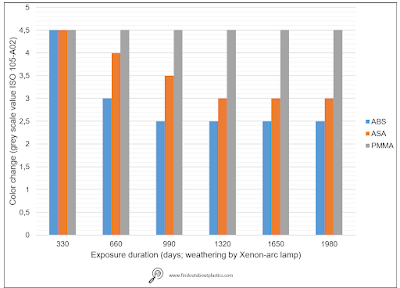
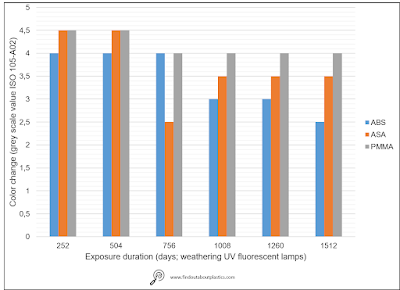
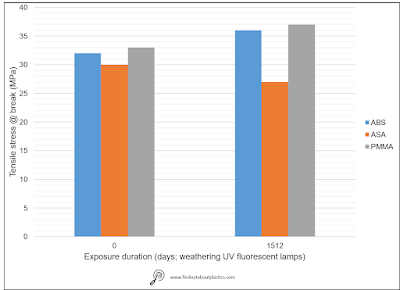
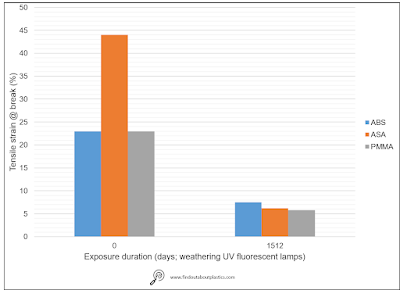
Mrs. Fatma Filiz Yildirim [4] investigated with her team the weathering methods on the properties of the ABS, ASA and PMMA. Testing was done by exposing the plastic parts to  natural weathering, Xenon-arc lamp, and UV fluorescent lamps for a certain period of time and then analyzed by grey scale (ISO 105-A02; 5 = low color change; 1 = high color change). Also, tensile strength was measured after exposure to natural weathering, Xenon-arc lamp, and UV fluorescent lamp. Figure 3, 4, and 5 show the results of the weathering study. The results indicate that PMMA has the best performance in all three weathering conditions. The xenon-arc lamp weathering method resulted in the lowest grey scale values for ABS and weathering by UV fluorescent lamps lead to the lowest grey scale with ASA samples. Reason for the change is the butadiene monomer containing double bonds which are broken up. This can be seen in the tensile strain values which change (materials harden and become brittle), whereas the tensile stress levels remain mostly at the same level for all three materials (Figure 6 and Figure 7). Using AES instead of ABS will allow you to have good high impact resistance (even at low temperatures) and UV resistance since the limitation by butadiene rubber is eliminated. 
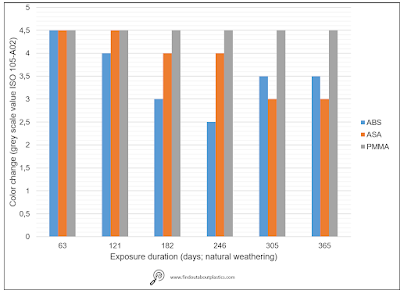
Figure 3: color change (grey scale) of ABS, ASA, and PMMA in natural weathering conditions [4].


Figure 4: color change (grey scale) of ABS, ASA, and PMMA as a result of weathering by Xenon-arc lamp [4].


Figure 5: color change (grey scale) of ABS, ASA, and PMMA as a result of weathering by UV lamp [4].


Figure 6: change of tensile stress @ break after weathering with UV lamp of ABS, ASA, and PMMA [4].


Figure 7: change of tensile strain after weathering with UV lamp of ABS, ASA, and PMMA [4]. 

Material selection guideline for outdoor applications

Figure 8 presents a relative comparison of selected properties of SAN, PMMA, ABS, ASA, and AES for supporting the selection of materials for outdoor applications. In the next post we will add the blends of ABS, ASA, AES, and PBT with PC to this list. 
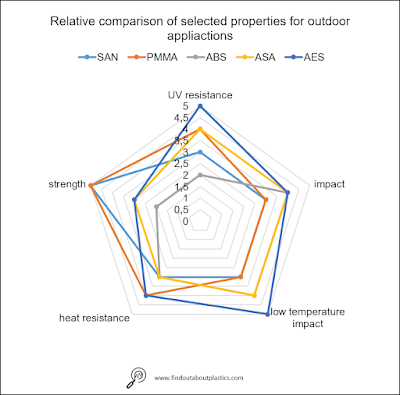
Figure 8: relative property comparison of SAN, PMMA, ABS, ASA, and AES.

Additionally, Table 2 compares the Global Warming Potential (GWP) of PS, SAN, ABS, and PMMA. The materials range in the range between >2 and <4 kg CO2 eq. which is compared to other engineering polymers such as Polyamide 6.6 (GWP 6.4 kg CO2 eq.) in a good range. GWP values can be still decreased by the usage of recycling materials and mass-balance approaches. 
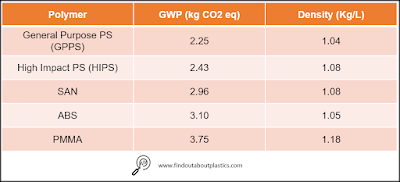
Table 2: comparison Global Warming Potential (GWP) of PS, SAN, ABS, and PMMA [9].

Finally, Figure 9 compares the elastic modulus E' (DMA) of PMMA, SAN, ABS, and HIPS to each other. For deciding on the material at different application temperatures,  the whole DMA curve of a material should be considered. It allows you assessing materials’ properties under different temperatures. Allover, SAN offers 3 GPa modulus sup to 100°C, together with transparency, in case it is needed. 


Figure 9: comparing the elastic modulus E' of PMMA, ABS, SAN, and HIPS [10].


Conclusions

ABS is an allrounder material which can be used for a variety of applications. You can cover from vacuum cleaner housing, Lego bricks to automotive applications which need to be plated. Downside is the resistance towards UV and weatherability. In this case, ASA and AES can take over the job since they have a long term resistance towards weathering and UV light. If transparency is needed, PMMA will support you, together with MABS. 


[1]https://prlresins.com/products/pc-asa-resin/
[2] https://www.findoutaboutplastics.com/2021/07/relative-comparison-of-material.html
[3] http://www.finevinyl.co.kr/shop/item.php?it_id=fineasa_eng
[4] https://www.sciencedirect.com/science/article/pii/S0142941822000137
[5] https://www.mexpolimeros.com/eng/aes.html
[6] https://infostore.saiglobal.com/preview/98705298668.pdf?sku=878631_SAIG_NSAI_NSAI_2087957
[7] https://www.smithers.com/industries/materials/polymer/physical-testing/material-properties-testing/optical-and-color-properties#Greyscale%C2%A0color%20change%20testing
[8] https://encompolymers.com/products/
[9] https://www.findoutaboutplastics.com/2021/12/eco-profiles-of-polymer-resins-global.html
[10] M. Sepe - Dynamic Mechanical Analysis for Plastics Engineers. 

Thursday, 5 October 2023

Design Properties for Engineers: Ionic Contamination of High Performance Polymers

Hello and welcome back to another post on design properties for polymer engineers. Today we discuss the ionic contamination of high performance polymers. I hope this data set supports you in case it is needed during your next polymer material selection project. More plastics design data can be found in my “start here” section.

Why is ionic contamination of plastics  important to know?

Imagine you would like to use plastics in high purity applications found in industries such as the semiconductor or photovoltaic industry. Also high levels of purity play a key role in the bio-, pharma-, and medical device industry. In particular, ions which leach out can cause due to their electrical loading a contamination of high purity processes. 

In Table 1 ionic concentration of selected high performance polymers can be found. In order to obtain the concentration, material samples were burned and the remaining ashes were checked regarding ions. In general, the selected polymers show low levels of contamination. PEEK shows a very low ionic contamination. Polyimides show higher values only at certain ions. 

Table 1: ionic concentration of selected high performance polymers [1]. 

[1] https://www.polytron-gmbh.de/downloads-uebersicht.aspx
[2] SAECHTLING KUNSTSTOFF TASCHENBUCH, Auflage: 31. Ausgabe Baur, Brinkmann, Osswald, Rudolph, Schmachtenberg

Wednesday, 4 October 2023

Design Properties for Engineers: Outgassing Behavior of High Performance Polymers

Hello and welcome back to another post on design properties for polymer engineers. Today we discuss the outgassing behaviour of high performance polymers in order to support you in your next polymer material selection project. More plastics design data can be found in my “start here” section.

Outgassing behaviour - total mass loss (TML)

In general, the outgassing behaviour of polymers is estimated by the total mass loss (TML) and the collected volatile condensed material (CVCM). Accepted values regarding high end applications (for example applications operating in vacuum) are for TML below 1% and for CVCM below 0.01%.

Table 1 shows the outgassing behaviour of high performance polymers. For Polyimides, TML values are ranging above 1% since they are hygroscopic polymers. However, looking at the CVCM values of Polyimides, it can be stated that they are in the same range as other high performance polymers (except PBI).  Nevertheless, Polyimides are suitable materials for applications operating in vacuum and proper drying must be ensured before application. Polyimides show excellent tribological properties for dynamic vacuum applications. 

Table 1: outgassing behaviour of high performance polymers (TML and CVCM) [1].

[1] https://www.polytron-gmbh.de/downloads-uebersicht.aspx
[2] SAECHTLING KUNSTSTOFF TASCHENBUCH, Auflage: 31. Ausgabe Baur, Brinkmann, Osswald, Rudolph, Schmachtenberg

Design Properties for Engineers: Radiation Resistance of High Performance Polymers

Hello and welcome back to another post on design properties for polymer engineers. Today we discuss the radiation resistance of high performance polymers to consider if needed in your next polymer material selection project. More plastics design data can be found in my “start here” section.

Resistance against radiation - radiation index

For evaluating plastics towards the suitability for radiation exposed applications, the so-called radiation index (Ri) can be used (IEC 60544-4). It is defined as the logarithm of base 10 of the absorbed radiation dose in Gray (J/kg) at which the flexural strength of the material is still minimum 50 % of the original value. The tests are done at room temperature and at a radiation dose of 200 kJ/kg per hour. 

In Table 1 (and Figure 1) the radiation index values of high performance/temperature polymers are shown. It can be seen that Polyimides PI and PAI have an extraordinary resistance towards radiation. Fluoropolymers do not show such a high resistance and PVDF even cross-links when exposed to high energy radiation. Additionally, Figure 2 shows the radiation index of often used commodity and engineering polymers.

Table 1: radiation resistance of high performance polymers [1].


Figure 1: radiation index of high performance polymers [1].
Figure 2: radiation index of commodity and engineering polymers [3].


Thanks for reading and #findoutaboutplastics!

Greetings

Herwig Juster

Literature:


[1] https://www.polytron-gmbh.de/downloads-uebersicht.aspx
[2] SAECHTLING KUNSTSTOFF TASCHENBUCH, Auflage: 31. Ausgabe Baur, Brinkmann, Osswald, Rudolph, Schmachtenberg
[3] https://contentmedia.lappcdn.com/e/lapp/WpLriclteLc9qgekEAj7bQ~~

Tuesday, 3 October 2023

Design Properties for Engineers: Hydrolysis Resistance of High Performance Polymers

Hello and welcome to this post on design data for polymer material selection in which we discuss the hydrolysis resistance of high performance polymers. More plastics design data can be found in my “start here” section.

Hydrolysis resistance - the resistance to attack by water

In general, hydrolytic resistance can be defined as the resistance to attack of the polymer structure by water. Hydrolysis resistance is part of the chemical resistance spectra and is important since water is very aggressive to many polymers. There are different tests on the estimation of hydrolytic resistance. One quick test is the immersion of a plastic specimen in boiling water for several days. Another method is to place a specimen 3 hours long at 105°C or even 5 hours long at 121°C in the steam autoclave.

For example, the mechanism of hydrolysis of Polyester polymers (PET, PBT) is the reaction of water with ester groups at high temperature. Also with Polyamide 6, reaction with water at high temperature will result in a split into caprolactam and oligomers. Polyurethanes will split into polyols and amines at high temperature and water exposure. 

Hydrolysis resistance data of high performance polymers

Table 1 shows the hydrolysis resistance data of high performance polymers and Figure 1 compares the hot water resistance of an aliphatic Polyamide 6.6 and a Polyphenylene sulfide (PPS) at 110°C and 6000 hours. Already around 2000 hours a delta of almost 10% can be seen which increases even more with time. Important for both material is that the glass fiber used has a hydrolysis resistant sizing

Table 1: hydrolysis resistance data of high performance polymers.

Figure 1: hot water resistance of a PA and a PPS, 110°C, 6000 hours. 

Thanks for reading and #findoutaboutplastics!

Greetings

Herwig Juster

Literature:

[1] Polytron - Materialeigenschaften Hochleistungskunststoffe

[2] https://www.solvay.com/en/brands/radel-ppsu

[3] Grivory HT - Enhanced properties at high temperatures

[4] https://www.curbellplastics.com/materials/applications/hydrolysis-resistant/

[5] https://www.fastradius.com/resources/hydrolysis-resistant-plastics/

[6] https://eu.mitsuichemicals.com/sites/default/files/media/document/2018/f-01-06_boiling_water_resistance.pdf

[7] http://www.bosy-online.de/Korrosion/Alterung_SA.pdf


Tuesday, 15 November 2022

Design Properties for Engineers: Chemical Resistance of Plastics - An Overview for Material Selection

Hello and welcome to a new post in which we discuss the chemical resistance of commodity and engineering polymers. High performance polymers we discuss in this post here.

Chemical Resistance of Plastics

In general, the chemical resistance of polymers towards certain chemical compounds can be estimated at different temperatures and times. Usual tests are conducted at room temperature for 30 days [1]. In material selection, the preparation phase is a key success element. During this phase it is important to collect as much information on environmental conditions as possible (consider the trinity of thermal, chemicals and time). 

Table 1 supports you in this phase. The chemical resistance of selected commodity and engineering plastics was tested and compared to each other. It can be a first indication, however your specific grade must be checked again towards the chemical it will be exposed to in the final application. Most material suppliers have already done extensive testing to make things faster and easier for you. 

Table 1: Chemical Resistance of Plastics - An Overview for Material Selection

Additionally, I created an interactive dashboard using Tableau which allows you to fast filter the polymer and the chemical for a fast analysis: 


Also, I made a short training video on this topic: 

Check out the other Design Properties for Engineers posts. 

Thanks for reading and #findoutaboutplastics

Greetings

Herwig 

Literature:

[1] https://www.buerkle.de/files_pdf/wissenswertes/technology_properties_of_plastics_en.pdf

[2] Erwin Baur, Dietmar Drummer, Tim A. Osswald, Natalie Rudolph: Saechtling Kunststoff-Handbuch, Hanser Verlag 


Tuesday, 23 August 2022

Plastic Multipoint Design Data: Specific Heat Capacity as a function of Temperature

Hello and welcome to a new blog post. Today I will show you another set of multipoint design data: specific heat capacity as a function of temperature. 

In a previous post I presented to you the Global Warming Potential (GWP) as a function of the heat capacity. However, the heat capacity values were limited to one temperature only (20°C). 

Increasing the temperature of a polymer by a dT at constant pressure is the result of a specific amount of heat supplied to the system. This is referred to as specific heat. 

Figure 1 presents the specific heat of amorphous and semi crystalline unfilled polymers. With increasing temperature the specific heat of both amorphous and semi crystalline polymers is increasing.


Figure 1: Specific heat capacity Cp as a function of temperature of amorphous and semi crystalline unfilled polymers.

There are several calculations in polymer engineering where the specific heat value of a certain polymer is needed: 

-calculation of the pressure drop along the gate or runner of an injection mould 

-dimensioning extrusion dies

-thermal design of moulds

-predicting the flow length of spiral melt flows

-polymer material selection for thermal management applications (thermal diffusivity)

Here you can find further design property data of various polymers for your part design and material selection. 

Thanks for your reading and #findoutaboutplastics

Greetings,

Herwig Juster


Literature: 

[1] VDI Wärmeatlas

[2] Griesinger: Wärmemanagement in der Elektronik

[3] Natti: Design Formulas for Plastics Engineering 


Friday, 27 May 2022

Plastic Part Design Properties for Engineers - Water Uptake of Aliphatic Polyamides

Hello and welcome back to a new post. Today we discuss the water and moisture uptake of aliphatic short and long chain Polyamides. In a previous post I discussed the water uptake for high performance polymers - check it out here. Here you can find a collection of all my "Design Properties for Plastics Engineering" posts. 

Properties of Polyamides

In general, Polyamides are often used as engineering material due to their high thermal stability, very good strength and hardness, combined with high mechanical damping characteristics and good chemical resistance. However, all Polyamides are hygroscopic due to the polar amide groups which form hydrogen bonds with water. Water absorption (at a given temperature and relative humidity) is proportional to the amount of amorphous part of the Polyamide. As a consequence, the water acts as a plasticizer and lowers the mechanical properties. At higher temperatures, hydrolysis can take place too. 

How much is the water uptake of aliphatic Polyamides? 

Figure 1 shows the water uptake situation of the most used aliphatic Polyamides at equilibrium in 50% relative humidity and at equilibrium in complete saturation.

Figure 1: Water uptake data of most used aliphatic Polyamides

Long chain aliphatic Polyamides such as PA 6.10, PA 6.12, PA 11, and PA 12 show a lower water absorption compared to PA 6, PA 6.6, and PA 4.6.  Higher dimensional stability, together with low variation in the properties during ambient humidity changes are the result. Major reason for the lower water uptake is the relatively long hydrocarbon chain length (limiting the amide groups to form hydrogen bonds with water).

Important during material selection is the consideration of the  behavior of Polyamides when they are exposed to water (part immersion) or humid environment. The part dimensions need to be still kept within the specified tolerance. If a lower water uptake material with high dimensional stability compared to Polyamide, Polyketone can be a good alternative. Figure 2 compares the water absorption at saturation level of Polyamide PA 6.6 and Polyketone (23°C; weight-%). Polyketone reaches the saturation level at 2.1 % weight increase, where else PA 6.6 at 8.5 weight-%. 

Figure 2: Comparison water absorption of PA 6.6 and PK [4]. 

Thank you for reading and #findoutaboutplastics.

Greetings

[1] https://www.findoutaboutplastics.com/2020/12/design-properties-for-engineers-water.html

[2] https://www.sciencedirect.com/science/article/pii/S2590048X20300911

[3] https://www.hanser-elibrary.com/doi/book/10.3139/9783446437296

[4] https://www.poketone.com/en/index.do

Monday, 20 September 2021

Design Properties for Engineers: UL RTI vs HDT of Commodity, Engineering and High Performance Polymers

In this blog post, we compare the long-term thermal properties (based on UL RTI 746B) to the short-term properties (based on the Heat Deflection Temperature, HDT @ 1.8 MPa).

The figure below shows the comparison of the long-term and short-term thermal data. This allows designers to immediately assess the suitability of a selected polymer in terms of continuous heat exposure as well as short-term heat impact. Furthermore, alternative polymers can be selected too.

UL RTI vs. HDT (1.8 MPa):Long-Term vs. Short-Term Thermal Properties of Thermoplastics


I made a YT video which shades light into this topic in more detail:


Thank you for reading and #findoutaboutplastics

Greetings

Herwig Juster

#materialselection #polymerengineering #plasticsdesign

Interested to talk with me about your plastic selection and part design needs - here you can contact me 

Interested in my monthly blog posts – then subscribe here and receive my high performance polymers knowledge matrix.
New to my Find Out About Plastics Blog – check out the start here section

Literature:

[1] UL Prospector – 746B

Tuesday, 7 September 2021

Design Properties for Engineers – Comparison Property Data of Polyphthalamides (PPAs)

 Hello and welcome to a new post. In this post I provide you engineering comparison data of the 5 most used PPA base polymers and their glass-fiber reinforced compounds. Semi-aromatic polyamides are used when the aliphatic counterparts reach their limits due to high temperature and/or mechanical loads.

The five base polymers of PPA are:

-PA 6T/6.6

-PA 6T/6I/6.6

-PA 6T/6I

-PA 6T/DT

-PA 10T/X

The data are shown in property vs. density plots and we are comparing the semi-aromatic polyamides to aliphatic polymers.  

Background

Semi-aromatic polyamides have an amide linkage together with an aromatic ring. The aromatic content is most of times derived from 2-methylpentanediamine (DT), terephthalic acid (TPA) and/or isophthalic acid (IPA). In general, the aromatic structure helps to increase the glass transition temperature, which in turn increases the thermal and chemical resistance. Furthermore, reduction in water uptake is achieved. More details can be found in this post.

The following properties are presented in the below infographic (PPA reinforced with 50% glass fibers):

-Glass transition temperature

-Melt temperature

-Tensile strength (dry as moulded; conditioned)

-Tensile modulus (dry as moulded; conditioned)

-Heat Deflection Temperature (HDT; 1.8 MPa)

-Izod notched impact strength


Design Properties for Engineers – Comparison Property Data of Polyphthalamides (PPAs)

Thanks for reading and #findoutaboutplastics

Greetings,

Herwig

Interested to talk with me about your plastic selection and part design needs - here you can contact me 

Interested in my monthly blog posts – then subscribe here and receive my high performance polymers knowledge matrix.
New to my Find Out About Plastics Blog – check out the start here section

Literature:

[1] D. Kemmish: Practical Guide to High Performance Engineering Plastics, Smithers

[2] D. Glasscock: High Performance Polyamides Fulfill Demanding Requirements for Automotive Thermal Management Components, DuPont Engineering Polymers

[3] Eurotec: Tecomid High Performance Compounds

[4] Saechtling Kunststoff Taschenbuch, Hanser