Showing posts with label additives. Show all posts

Sunday, 3 May 2026

Influence of fillers on the efficiency of Antioxidants in Polypropylene (PP)

Hello and welcome to a new blog post in which we discuss the influence of fillers on the efficiency of Antioxidans additives in Polypropylene (PP). 

Fillers and Antioxidant Efficiency in Polypropylene

The Figure 1 highlights an important point about the long-term thermo-oxidative stability of polypropylene (PP): not all fillers are neutral in their effect on ageing performance. 

Under oven ageing at 160°C, the results show a clear reduction in time to embrittlement for PP filled with talc and calcium carbonate (CaCO₃) compared with unfilled PP. 

In other words, both fillers have a negative impact on long-term stability under these conditions, with talc showing the strongest reduction. The figure is a useful reminder that filler selection must be considered not only from a cost and stiffness perspective, but also from the standpoint of antioxidant efficiency and durability.


A note on testing for plastics embrittlement

The standards ASTM D5510 (Standard Practice for Heat Aging of Oxidatively Degradable Plastics) and ASTM D3045 (Standard Practice for Heat Aging of Plastics Without Load) were used with regular tensile testing during oven aging (ISO 527 / ASTM D882). Focus is not so much on tensile strength, but more on Elongation-at-break which is the most direct indicator of embrittlement. 

A sharp drop (often to <50% of its original value) indicates the PP has become brittle. A brittle PP might maintain its tensile strength, it will snap almost immediately when bent or stretched. 

Check out my other posts on additives here:

The Important Role of Additives: Enhancing Polymer Properties for High Performance Applications (Part 1)

Thanks for reading & #findoutaboutplastics!

Greetings, 

Herwig 

Literature: 

[1] https://www.linkedin.com/posts/herwigjuster_findoutaboutplastics-share-7454851060814348289-PnnQ?utm_source=share&utm_medium=member_desktop&rcm=ACoAABCkmMcBev71cuhh4-jzEaiPHFO5VFb4aO0

[2] M. Bonnet - Kunststoffe in der Ingenieuranwendung

Wednesday, 23 August 2023

The Important Role of Additives: Enhancing Polymer Properties for High Performance Applications (Part 4 - Example of Common Agents and Polymer Compounding)

Hello and welcome to the fourth part of our plastic additives series.

Here you can read the other parts:

Part 1

Part 2

Part 3

In this post we discuss the common agents used for the different types of additives. We cover a broad range of agents, from anti-blocking to UV-stabilizer agents. Table 1 lists the different additives together with the corresponding agents.

Table 1: Plastic additives with their common used agents [1].

The keys to successful polymer compounding

Now with the knowledge of plastic additive agents, creating structural and functional materials may be easier. Structural polymer compounds are used in transportation (automotive, rail, airplanes, aerospace), machinery, and building industries. Their prime requirements cover high mechanical, thermal, and chemical properties. Functional polymer compounds on the other hand are used in (micro)electronics, communications, information technology, and biotechnology. Their prime requirements cover excellent electrical, magnetic, optical, and biological properties.
The essential of plastics compounding I have described in the post here and it can be summarized in this formula:
Successful polymer compounding = material properties + processing methods + end product properties

Thanks for reading and #findoutaboutplastics

Greetings,

Herwig

Monday, 19 December 2022

The Important Role of Additives: Enhancing Polymer Properties for High Performance Applications (Part 3)

Hello and welcome to the third part of our plastic additives series. In this post we discuss how to improve the conductivity (thermal and electrical) of polymers by using different filler systems. 

 Here you can read part 1 and here part 2

Volume vs weight of fillers

Before we deep-dive, let us clarify an important consideration: volume vs. weight of fillers. For formulating a plastic compound, understanding the volume fraction is key. For compounding we need to translate it to a weight based unit, since it is easiest for the extrusion process to set a weight unit and not volume. 

Key is to plot your compound properties as a function of volume percent and not weight percent. It will result in straight lines and not exponential as with weight percentage. Figure 1 shows a PP loaded with different fillers and the filler level is expressed over the volume percentage [1]. 

Figure 1: thermal conductivity of PP and different fillers as a function of filler volume % [1].

Thermal conductivity of metals, carbon, and ceramics

Before we compare specific fillers used in plastic compounds to increase the thermal conductivity, we have a look at the thermal conductivity of selected metals, carbon, and ceramics (Table 1). This allows us to get a first feeling for the different thermal conductivity levels, together with the densities. 

Table 1: overview thermal conductivity of selected metals, carbon, and ceramics

Electrically conductive and non-conductive fillers for plastic compounds

If you are confronted with the task to improve the thermal conductivity of your polymer, Table 2 can serve as a starting point. If one of the requirements during material selection is to fulfill a certain thermal conductive level, optimal fillers are key. Ceramic based fillers such as Boron nitrite show a high thermal conductivity, however due to the plate shape, it is high in plane direction and lower through plane. Spheric fillers allow for a more uniform conductivity in the final plastic part. 

Table 2: electrically conductive and non-conductive fillers for plastic compounds.

Check out part 1 and here part 2 too. 

Thanks for reading and #findoutaboutplastics

Greetings, 

Herwig 


Literature: 

[1]  https://phantomplastics.com/plastic-materials-training-from-a-top-expert/learn-about-filled-plastics/

[2] Gächter and Müller: Plastics Additives


Saturday, 29 October 2022

The Important Role of Additives: Enhancing Polymer Properties for High Performance Applications (Part 2)

Hello and welcome to a new post. Today we continue with the second part of our plastic additives series. In this post we discuss how fillers change the properties of polymer compounds and how we can use this during material selection

Here you can read part 1.

General effects caused by fillers

Table 1 shows the effects on Elastic-modulus, elongation, toughness, flames resistance, and dimensional stability caused by different fillers such as glass fibers, UV-stabilizers, and flame retardants. UV-stabilizers, flame retardants (organic and inorganic), and anti-statics show a negative impact on the modulus of elasticity, elongation and toughness. 
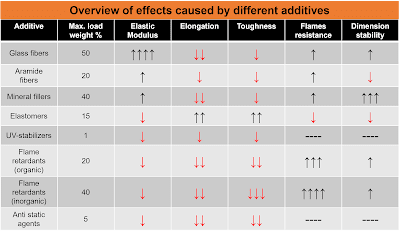
Table 1: overview of effects caused by different additives [adapted from 2]

Modification of properties by using isotropic, flaky, and fiber shape additives

Now with the know-how of Table 1 it is possible to influence certain properties by using different additive geometries. In general, isotropic fillers have the same behavior in x-, y-, and z-direction and improve the dimensional stability of your final part. Platy shaped fillers are very good in the x- and y-direction however not so good in z-direction. Fibers are only good in one direction and show a fair behavior in the remaining two. 
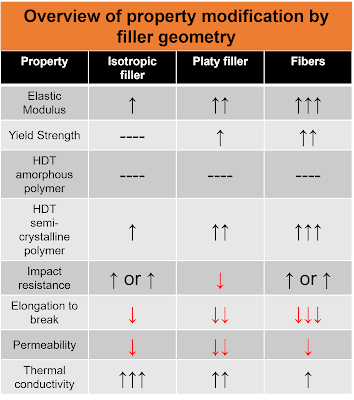
Table 2: overview of property modification by filler geometry [3]

Example on warpage control of semi-crystalline polymers

In Table 1 and Table 2 we discussed how to improve the dimensional stability of polymers. In this example we have semi-crystalline polymer with a glass fiber loading and we would like to have a better hand on the warpage control of the final part. The glass fiber loading causes a different shrink rate in x-direction than in y-direction leading to warping of the part. If we take a semi-crystalline polymer with isotropic filler loading, shrink rate in x- and y-direction are the same, however the final part will show a low strength. The key is to combine glass fibers with isotropic filler in order to obtain a flat part with good strength properties. 

How to do it? 

A common compounding solution is to use 15 weight-% glass fiber and combine it with 25 weight-% mineral or beads. 

Example improvement of wear resistance of amorphous polymers

In case you consider an amorphous polymer such as Polycarbonate (PC) for applications which need to have a certain level of wear resistance (for example gears), an effective way is to use PTFE as a lubrication additive. This is demonstrated in Table 3, where 15 weight-% PTFE is added to a PC. Both, the wear factor and the dynamic coefficient of friction could be reduced. 
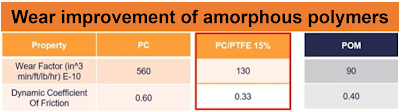
Table 3: wear improvement of amorphous polymers

Example Polyamide 6.6 (PA 6.6): filler vs. reinforcement

In general, by using fillers we can have a good shrink control, improve the modulus of elasticity, and heat distortion. Impact resistance will decrease and strength will remain the same. Using reinforcements, strength and modulus will improve, together with heat distortion. Regarding impact resistance, reinforcements will make brittle resins tough and tough resins brittle. Table 4 compares an unfilled PA 6.6 with a 40 weight-% talc filled and a 40 weight-% glass fiber reinforced PA 6.6 to better illustrate the main differences of filler and reinforcement. 
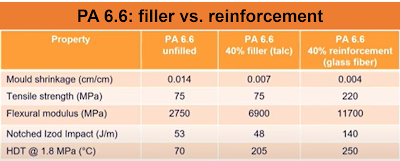
Table 4: PA 6.6 - filler vs. reinforcement

Example POM (Acetal): filler vs. reinforcement

In the next example we have an unfilled POM homopolymer (Table 5) and glass as filler and reinforcement. Filling the POM will increase the tensile modulus, however tensile strength will decrease. Reinforcing with glass by using a proper sizing of the glass which can be coupled to the polymer, tensile strength and modulus can be increased. 
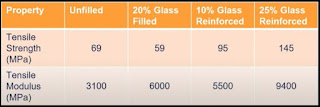
Table 5: POM - filler vs. reinforcement

In the next part we discuss how to improve the conductivity (thermal and electrical) of polymers. 

Here you can jump to part 1 and here to my posts on flame retardants, as well as CTI improvement strategies, involving additives. 

Thanks and #findoutaboutplastics

Greetings, 

Herwig 


Literature: 

[1] Gächter and Müller: Plastics Additives

[2] DuPont and Biesterfeld Interowa - Design with plastics, 2011

[3] Chris DeArmitt: https://phantomplastics.com/plastic-materials-training-from-a-top-expert/learn-about-filled-plastics/

[4] https://youtu.be/h7iUC9-JdiU

[5] https://youtu.be/nLGcSszTaTs

[6] https://www.youtube.com/watch?v=1pPx1YbGDBA


Tuesday, 11 October 2022

The Important Role of Additives: Enhancing Polymer Properties for High Performance Applications (Part 1)

Hello and welcome to a new blog post. Today’s topic is the important role of polymer additives and since it is a broad topic I will split it into several parts.

Part 2

Part 3

In the first part we discuss the types of additives and things to consider when you use additives in material- and application development.  Having a basic understanding of fillers and what they can enable in a plastic compound is important for polymer material selection too. 

What can additives do for your polymer?

The limited usage range of certain polymers can be improved by incorporating additives into the polymers. Thinking of polyolefins, without adding antioxidants, not even processing would be possible in a proper way. Another example is rigid PVC which can be made flexible by adding plasticizes. Adding glass fibers to Polyamide 6 increases the heat distortion temperature (HDT), as well as strength and stiffness. Using color pigments allows the PC to be moulded in several colors and PP can be made radiation stable by adding free radical scavengers. Conductive fillers turn polymers from an isolator to a material which can be used as a heat sink. Another example is the chemical compound Piperine which is responsible for the spicy appearance of black pepper. It is added during fuel line extrusion for cars to prevent biting of cables due to animals. If they bite, it will start hurting and they will immediately stop. 

Additives can turn brittle polymers such as Polystyrene into a toughened polymer by using impact modifiers. Also can additives improve processing, dimensional stability, and strength. Furthermore, they can improve thermal, radiation, and light stability. They are able to improve the flame retardant level and turn for example Polyesters flame retardant and improve long-term aging, scratch resistance, aesthetics, and biocompatibility.  Another example is that additives can improve electrical properties such as the Comparative Tracking Index (CTI)

Polymer material performance: the effects of additives in an overview

Table 1 shows the different additive classes and their effect in the final plastic compound. Flame retardant additives we discussed previously already here

Table 1: Overiew of different additive classes and their effect in the final plastic compound.

What do we need to consider when we use additives? 

The different effects of various additives on the final compound need to be considered by the formulators. Physical and chemical properties, toxicity, sterilization as well as biocompatibility (in case of health care applications) must be evaluated. Also checking the shelf life of the new material compound needs to be considered since the used additive may cause some side reactions which lead to a decrease in properties. 

In the next part we discuss how to modify the properties of compounds by using different shaped fillers. 

Thanks and #findoutaboutplastics

Greetings, 

Herwig 


Literature:

[1] Gächter and Müller: Plastics Additives

[2] Sastri - Plastics in Medical Devices: Properties, Requirements, and Applications