Thursday, 20 June 2019

Polyphenylene sulfide (PPS) – The Conquering of Electric Car Parts


In this blog post I explain why polyphenylene sulfide (PPS) is conquering more and more key parts in higher voltage electric cars. In my electrification series, I have discussed the requirements of certain parts already in detail as well as which advanced polymers can be used. A major one is PPS.

Currently, a typical internal combustion engine (ICE) has around 700 grams of PPS polymer on board. New numbers form Asia reveal that there will be 3 to 4 kg of PPS in electric vehicles (EVs) and hybrid electric vehicles (HEVs). This is a huge increase. Let’s find out why it is so heavily in use.

Reason number 1: Elevated temperatures during usage over a long lifetime (over 6000 hours)
Applications such as capacitor cases, invertor cores, motor cores and housings have to withstand elevated temperatures during use and need to have excellent heat cycle performance. PPS can fulfill these set of requirements in an economic manner.

Reason number 2: Thermal management systems
Cooling of the battery and the electric motor requires water pumps. The latter need to perform when constant exposed to the water-glycol mixture. The outstanding thermal and chemical performance of PPS makes it a very suitable candidate for any application inside the water pump, e.g. impellers. Cooling of the battery is necessary when the car is charging as well. As such the lifetime expectation of (plastic) parts is also higher.


Reason number 3: Good metal overmolding capabilities
Busbars are usually thick copper lines which need to be overmoulded. Here again, processing of PPS due to good flow properties is an advantage together with its good electrical insulation properties.

Reason number 4: Dimensional stability at ambient conditions
Exterior positioning sensors in electrical vehicles need to be dimensional stable at various ambient temperatures and humidity. This ensures accurate positioning detection. In this context, PPS exhibit negligible water uptake which makes them suitable for external positioning sensors. For instances, Nylons would be less of suitable candidates here due to their inherent higher hydrophilicity.

Reason number 5: Price level suitable for automotive market
With PPS you will get a lot of value for a reasonable price, i.e. continuous use temperature of 200-240°C, UL94 V0 rating, chemically resistance up to 200°C and dimensional stability at ambient conditions. Price is a major advantage in comparison to other high performance polymers.

A short word on linear vs cross-linked PPS:
There are three major routes to obtain PPS. First one is called flash process with curing. The curing step is needed to increase molecular weight [2]. This process results in branched PPS. The second route encompasses the flash process and metal carboxylates and results in linear PPS [3]. The third route is over the quench process and results in linear PPS as well [3]. Leaders in the industrialization of the PPS polymerizations were Chevron Philips and Kureha back in the 1980s. For electric vehicles, linear types of PPS are optimal. These show superior toughness and improved weldline strength. In general, linear PPS does not process as well as cross-linked PPS. However, less moulding flash is generated by linear PPS types.


What are the potential downsides of using PPS for e-mobility applications?
One aspect to consider is the comparative tracking index of PPS which is between 250 and 275 Volts. This is low compared to PPA which can easily reach 600 Volts. Another point is its low thermal conductivity, 0.3 -0.5 W/mK and finally its brittleness.


Besides PPS, what are next best candidate materials?
In the table below, I have listed polymers which can be in competition for applications using PPS: syndiotactic polystyrene (sPS), polybutylene terephthalate (PBT), and polyphthalamide (PPA).


Conclusion:
PPS, branched or linear, are in the lead for e-mobility applications, especially for high temperature electronics. Automotive, regardless of ICE or EV, will be the main driver for using PPS. This was a wrap up on PPS used in electrification applications.


I hope you have enjoyed it!
Till next time!
best regards,
Herwig Juster

If you liked this post, share and like!
Interested in my monthly blog posts – then subscribe here.
New to my Find Out About Plastics Blog – check out the start here section.
Check out also my personal webpage.


Literature:
[1] https://www.plasticstoday.com/automotive-and-mobility/chinaplas-pps-recording-explosive-growth-evs/50108596960874
[2] Nexant Chemical Systems
[3] Solvay Specialty Polymers – Ryton PPS https://www.solvay.com/en/brands/ryton-pps
Sunday, 16 June 2019

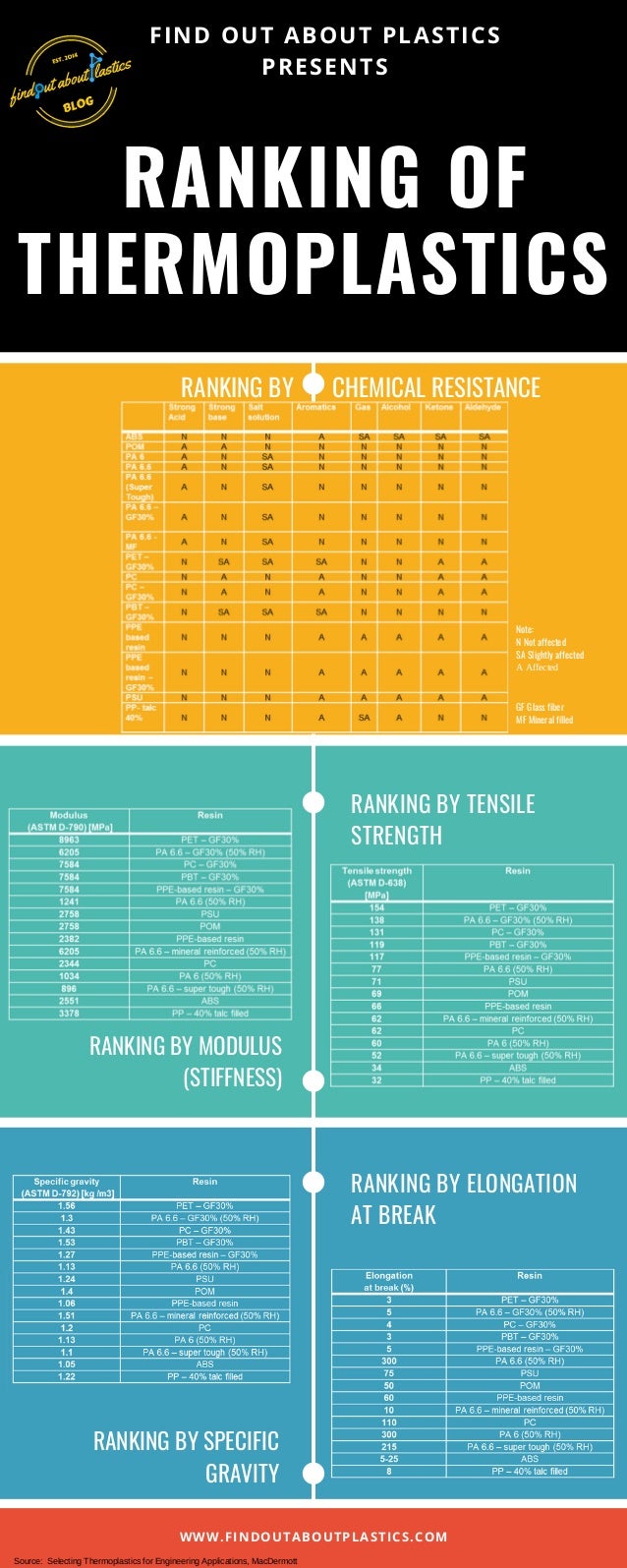
Ranking of Thermoplastics [Infographic]

Hello everyone to this post. Quick accessible knowledge about some properties of the most used engineering plastics can be key during the designing and material selection phase of your product. In this blog post I present to you an infographic which contains several tables providing design information.

Enjoy it and till next time!
Thank you for reading!

Herwig Juster
If you liked this post, share and like!
Interested in my monthly blog posts – then subscribe here.
New to my Find Out About Plastics Blog – check out the start here section.
Check out also my personal webpage.


Property Ranking of Thermoplastics - Updated Version (September 2021) 

Monday, 27 May 2019

High Performance Polymers in Electrification: A Must-Have Or A Nice-To-Have (Part 2: Traction Motors)


High Performance Polymers for E-Mobility (Part 2: Traction Motor); Source: findoutaboutplastics.com


Welcome back to the second part of the high performance plastics for electrification series. In the first part, we have discussed the polymeric materials used in battery systems. Now, we investigate the high performance plastics used in traction motors and transmission components.

Traction motor with transmission – turning voltage into movement:

In the next years the power density of electric cars will increase and this is followed by an increase in voltage. We will see cars with 800 V systems, which doubles today’s system voltage. As a consequence, system temperatures (120-140°C) and torque (up to 300.000 RPM) will increase and insulation properties and safe operation will have highest priority.

-Magnet wire coating:

To ensure safe operations at increased torque and voltage system levels, traction motors and power modules require the usage of polymers such as polyphthalamides (PPA), polyphenylene sulfide (PPS), and polyether ether ketone (PEEK). Magnet wire insulation can be achieved by using an extruded layer of PEEK on the rectangular shaped copper cable. The PEEK magnet wire coating allows for higher cable packing density and thus increased power. Furthermore, by using PEEK, high dielectric strength, chemical resistance, and thermal stability can be achieved. Abrasion resistance of magnet wires is a key property too and is fulfilled by PEEK.
In the picture below the cross section of a traction motor can be seen. In light brown, the PEEK extruded magnet wires can be seen. This example was shown at the Fakuma 2018 (Friedrichshafen, Germany) at the Solvay booth. The traction motor is from Essex Furukawa.


Magnet wire coating solution using PEEK, Solvay booth, Fakuma 2018  

Slot liners which guide the copper cables can make use of different high performance polymers such as PEEK or polyimide (PI) film solutions. Liquid crystal polymers (LCP) can be used for slot liners as well. LCP allows achieving long flow length and wall thickness down to 0.4 mm. Furthermore, LCP’s have a high relative temperature index (RTI) of 220°C combined with inherent V0 properties. Other alternatives are PI and aromatic polyamide (=aramide) sheets, which are folded and inserted in the stator as insulation.
Electronic components of the traction motor include terminals, bobbins, resolvers, and inverters. For such kind of components PPS and PPA can be used. PPA can achieve a Comparative Tracking Index of over 600 V and is available with organic-based heat stabilizers to prevent galvanic corrosion. PPS is inherently V0. However, it does not reach as high CTI values as PPA. Most PPS grades show CTI values of 280. There are PPS grades with 500 V, but the mechanical properties drop significantly, which makes them not suitable for such applications.
Traction motors can be directly cooled by using dielectric fluids such as PolyFluoroPolyEthers (PFPE). The latter, can also be used as lubricant components to prevent friction and wear. Proper lubrication ensures that traction motors can be operated up to 1.2 million kilometers with little maintenance efforts.

Power Distribution Units (PDUs)

For PDUs, the materials requirements are similar to traction motors: high dielectric strength, easy flow, weldline strength, thermal shock resistance, dimensional stability and flame retardant (V0) properties. PPA and PPS, together with PEEK fulfil this set of criteria.

– Insulated-gate bipolar transistor (IGBT):

In components like the insulated-gate bipolar transistor (IGBT), plastic components can be in direct contact with the printed circuit board (PCB). As a result, requirements for selected polymers are dimensional stability around 120°C - 150°C, CTI of 600 V, electric volume resistivity and most importantly, halogens are not allowed to gas out of the part. PPA and PPS can fulfill such stringent requirements since they have a high dielectric strength and are easy to process. Weldlines represent always a design challenge, however PPA and PPS have a good weldline strength (approx. 100 MPa). Increased current leads to temperature increase, which can also be easily handled by PPA and PPS type of polymers.


With this I will close the second part of this high performance polymers series for EV. In the third part, we will look into autonomous driving systems.

Thank you for reading!
Till next time!
Herwig Juster

If you liked this post, share and like!

Interested in my monthly blog posts – then subscribe here.
New to my Find Out About Plastics Blog – check out the start here section.
Check out also my personal webpage.

Saturday, 18 May 2019

What is the thermal conductivity of plastics? Thermal conductivity of 96 plastics for EV application design support

Thermal conductivity of 96 plastics

In emerging electric vehicle applications which includes traction motors, battery cages, and power electronics the focus is kept more and more on the material parameter “thermal conductivity”. Removal of entrapped heat is important due to heat’s high impact on overall system performance. Thermal conductivity is the transfer of heat from one body to another body which is in contact with first. It is measured as W/mK.

The rule of thumb for thermal conductivity in plastics is as follows:
1. For amorphous thermoplastics at 0-200°C, the thermal conductivity lies between 0.125-0.2 W/mK.
2. For semi-crystalline thermoplastics at 0-200°C, values can exceed 0.2 W/mk. Inherently ordered crystalline regions lead to higher thermal conductivity

“What is the thermal conductivity of xyz-plastic?”
I created a table based on published literature, which can support you in quickly accessing thermal conductivity data of different polymers. There are some compounders which have specialized in offering thermal conductive, electrical insulated polymers, reaching over 1 W/mK.


Thermal conductivity of plastics overview
Thank you for reading and till next time!
Herwig Juster

If you liked this post, share and like!

Interested in my monthly blog posts – then subscribe here.
New to my Find Out About Plastics Blog – check out the start here section
Check out also my personal webpage.


Literature:
[1] https://omnexus.specialchem.com/polymer-properties/
[2] Saechtling Plastics Handbook