Saturday, 20 July 2019

Take Me To The Moon – Celebrating 50 Years Moon Landing With High Performance Polymers


On July 20 1969, 50 years ago, Neil Armstrong and Buzz Aldrin touched ground on the moon. On this day, Neil Armstrong said the well known quote: “That's one small step for (a) man, one giant leap for mankind.”
The Apollo 11 crew was well equipped with latest technology. This included two high performance polymers constituting their helmet visors: polycarbonate (PC) and polysulfone (PSU).

Why were polycarbonate and polysulfone used for the helmet visors?

Polycarbonate as protective helmet visor:

Polycarbonate can be regarded as the benchmark for all existing impact resistant plastics. It got its name from the containing carbonate groups (−O−(C=O)−O−) in its backbone. These promote temperature and high impact resistance as well as an amorphous macromolecular structure which leads to excellent optical properties. High energy is needed to tear its chains apart. For these reasons, an ultraviolet-stabilized polycarbonate visor was used for protecting the heads of astronauts against impact and micrometeoroids. The protective visor could be moved independently of the sun protection visor. Back then, the Apollo mission used the newly developed polycarbonate Lexan® from GE Plastics [1].

Polysulfone as sun protection helmet visor:

Commercialized in 1965 by Union Carbide, Udel® Polysulfone (PSU) was right in time to be used as the external helmet visor. Polysulfone has a high service temperature (Tg = 190°C) in combination with reduced creep and dimensional stability. Among non-reinforced thermoplastics, polysulfone affords top high-temperature creep resistance. Another superior property of this plastic is that it retains its transparency after prolonged exposure to temperatures up to 200°C. This high temperature resistance property is to great extent imparted by the contained diphenyl sulfone groups. These characteristics made polysulfone suitable to be used as the sun protection visor (outer visor) in astronauts’ helmets [2,3], which main function was to protect the astronaut from sun exposure and high temperatures. For this, the inner surface of the polysulfone-based visor was also coated with gold for extended sun visor protection capabilities. The gold coating supported the protection against generated heat inside the helmet as well.

Thank you for reading this recap history!

Greetings,

Herwig 

Interested in my monthly blog posts – then subscribe here and receive my high performance polymers knowledge matrix.

!NEW! Ultra and High Performance Polymer Selection - new online course coming soon - join the waiting list

Literature:

[1] https://www.hq.nasa.gov/alsj/alsj-LEVA.html
[2] https://www.space.com/26630-apollo-11-vintage-tech-innovations.html
[3] https://www.ge.com/reports/post/74545208407/ge-phone-home-ge-technology-helped-fly-humans-to/
[4] https://omnexus.specialchem.com/tech-library/article/apollo-11-moon-landing-plastics-applications

Sunday, 30 June 2019

High Performance Polymers in Electrification: A Must-Have Or A Nice-To-Have (Part 3: Autonomous Driving)


Welcome back to the third part of the high performance plastics for electrification series. In the previous parts, we have discussed the polymeric materials used in battery systems and traction motors. Now, we a look at the high performance plastics used for autonomous driving applications.

Autonomous driving
  • Connectors
Connectors need to be reliable while driving (manual and autonomous driving mode) as well as when the OEM is assembling the different parts of the car in the manufacturing line. Therefore, connectors need to fulfil different requirements:
  • JEDEC MSL1 level of shelf life (=infinite);
  • no corrosion (especially pins; plastic parts need to be free of halogens, red phosphor, and ionic heat stabilizers);
  • continuous use temperatures of 140°C-180°C;
  • high chemical resistance;
  • high electric strength;
  • and CTI of 600 Volts (PLC0).

Connectors need to have a high ductility level too. Easy identification of high voltage connectors, insulators, and circuit breakers is achieved by coloring polymers in orange (color coding compulsory above 60 V). Polymers such as polyphthalamide (PPA) with a Tg of 120°C and above (Tg of 140 up to 180°C are possible) can handle the requirements listed above offering high mechanical strength with low moisture uptake, similarly to polyesters. Apart of aliphatic polyamides and polyesters, semi-aromatic polyamides such as PPA and polyarylamide (PARA) can be obtained in a non-halogenated flame retardant compound. Advantages of PARA are the high stiffness, excellent low creep, low moisture uptake and impact properties.


  • Light Detection and Ranging (LiDAR) and Radio Detection and Ranging (Radar) sensors
High performance plastics play an important role in connectors on the one hand as well as in sensors for autonomous driving on the other. An aliphatic polyamide absorbs water and moisture. This absorption is linked to a dimensional and mechanical change. LiDAR and radar housings need to be dimensional stable since their job is to scan the environment and create an accurate picture of the surrounding. Therefore, using polymers such as polycarbonate (PC), polyethersulfones (PESU), and polyphenylene sulfide (PPS) ensure the high dimensional stability combined with nearly no moisture uptake. Those polymers ensure safe communication of the different sensors over the life time of the vehicle.
  • Battery temperature sensors
Minimal temperature changes (+/- 1 °C) in the Li-ion batteries can impact their loading efficiency. Therefore, accurate management of the temperature by sensors is essential for keeping the batteries at their highest effectiveness level. For this type of sensors, polyethersulfones are best suited since their Tg is around 220°C and they show excellent dimensional stability. Furthermore, this stability is needed for keeping the sealing performance of the sensor’s O-ring seals.
  • 5G communication sensors
With the arrival of 5G mobile technology, our cars will be able to communicate with each other and the environment. Requirements for 5G related applications are mainly high speed data transmission, infrared transmission, retention of environmental influences and dimensional stability. Polymers such as polyether imides (PEI) and polysulfones are suitable to fulfill these requirements since their amorphous structure allows for tight tolerances and low CLTE, creep resistance and good IR transmission.
  • Outlook
In next steps, automotive exterior designers start to seamlessly integrate LED lighting systems with infrared transparency for LiDAR sensor systems [1]. In such application concepts, polycarbonates can play an important role. The integration of LiDAR systems into the car bumper will lead to another challenge: having clean lenses. This may be ensured by using fluorinated coatings which are based on fluoropolymer chemistry (e.g.  perfluoropolyether - PFPE).
  • Wrap-up
Electrification brings a whole mix of performance plastics in several applications. I have listed the material requirements and applications we discussed in this post including the previous two parts in two tables, which can serve as guidance through selecting the optimal polymer for your application.


Electrification application matrix for supporting polymer material selection


Material requirements of high voltage components in electric vehicles

Thank you for reading this third part of the electrification blog series! If you enjoyed it please do like and share it with your network.
Till next time!
best regards,
Herwig Juster
If you liked this post, share and like! Interested in my monthly blog posts – then subscribe here.
New to my Find Out About Plastics Blog –
check out the start here section.
Check out also my personal webpage: Herwigjuster.com


Literature:


Thursday, 20 June 2019

Polyphenylene sulfide (PPS) – The Conquering of Electric Car Parts


In this blog post I explain why polyphenylene sulfide (PPS) is conquering more and more key parts in higher voltage electric cars. In my electrification series, I have discussed the requirements of certain parts already in detail as well as which advanced polymers can be used. A major one is PPS.

Currently, a typical internal combustion engine (ICE) has around 700 grams of PPS polymer on board. New numbers form Asia reveal that there will be 3 to 4 kg of PPS in electric vehicles (EVs) and hybrid electric vehicles (HEVs). This is a huge increase. Let’s find out why it is so heavily in use.

Reason number 1: Elevated temperatures during usage over a long lifetime (over 6000 hours)
Applications such as capacitor cases, invertor cores, motor cores and housings have to withstand elevated temperatures during use and need to have excellent heat cycle performance. PPS can fulfill these set of requirements in an economic manner.

Reason number 2: Thermal management systems
Cooling of the battery and the electric motor requires water pumps. The latter need to perform when constant exposed to the water-glycol mixture. The outstanding thermal and chemical performance of PPS makes it a very suitable candidate for any application inside the water pump, e.g. impellers. Cooling of the battery is necessary when the car is charging as well. As such the lifetime expectation of (plastic) parts is also higher.


Reason number 3: Good metal overmolding capabilities
Busbars are usually thick copper lines which need to be overmoulded. Here again, processing of PPS due to good flow properties is an advantage together with its good electrical insulation properties.

Reason number 4: Dimensional stability at ambient conditions
Exterior positioning sensors in electrical vehicles need to be dimensional stable at various ambient temperatures and humidity. This ensures accurate positioning detection. In this context, PPS exhibit negligible water uptake which makes them suitable for external positioning sensors. For instances, Nylons would be less of suitable candidates here due to their inherent higher hydrophilicity.

Reason number 5: Price level suitable for automotive market
With PPS you will get a lot of value for a reasonable price, i.e. continuous use temperature of 200-240°C, UL94 V0 rating, chemically resistance up to 200°C and dimensional stability at ambient conditions. Price is a major advantage in comparison to other high performance polymers.

A short word on linear vs cross-linked PPS:
There are three major routes to obtain PPS. First one is called flash process with curing. The curing step is needed to increase molecular weight [2]. This process results in branched PPS. The second route encompasses the flash process and metal carboxylates and results in linear PPS [3]. The third route is over the quench process and results in linear PPS as well [3]. Leaders in the industrialization of the PPS polymerizations were Chevron Philips and Kureha back in the 1980s. For electric vehicles, linear types of PPS are optimal. These show superior toughness and improved weldline strength. In general, linear PPS does not process as well as cross-linked PPS. However, less moulding flash is generated by linear PPS types.


What are the potential downsides of using PPS for e-mobility applications?
One aspect to consider is the comparative tracking index of PPS which is between 250 and 275 Volts. This is low compared to PPA which can easily reach 600 Volts. Another point is its low thermal conductivity, 0.3 -0.5 W/mK and finally its brittleness.


Besides PPS, what are next best candidate materials?
In the table below, I have listed polymers which can be in competition for applications using PPS: syndiotactic polystyrene (sPS), polybutylene terephthalate (PBT), and polyphthalamide (PPA).


Conclusion:
PPS, branched or linear, are in the lead for e-mobility applications, especially for high temperature electronics. Automotive, regardless of ICE or EV, will be the main driver for using PPS. This was a wrap up on PPS used in electrification applications.


I hope you have enjoyed it!
Till next time!
best regards,
Herwig Juster

If you liked this post, share and like!
Interested in my monthly blog posts – then subscribe here.
New to my Find Out About Plastics Blog – check out the start here section.
Check out also my personal webpage.


Literature:
[1] https://www.plasticstoday.com/automotive-and-mobility/chinaplas-pps-recording-explosive-growth-evs/50108596960874
[2] Nexant Chemical Systems
[3] Solvay Specialty Polymers – Ryton PPS https://www.solvay.com/en/brands/ryton-pps

Sunday, 16 June 2019

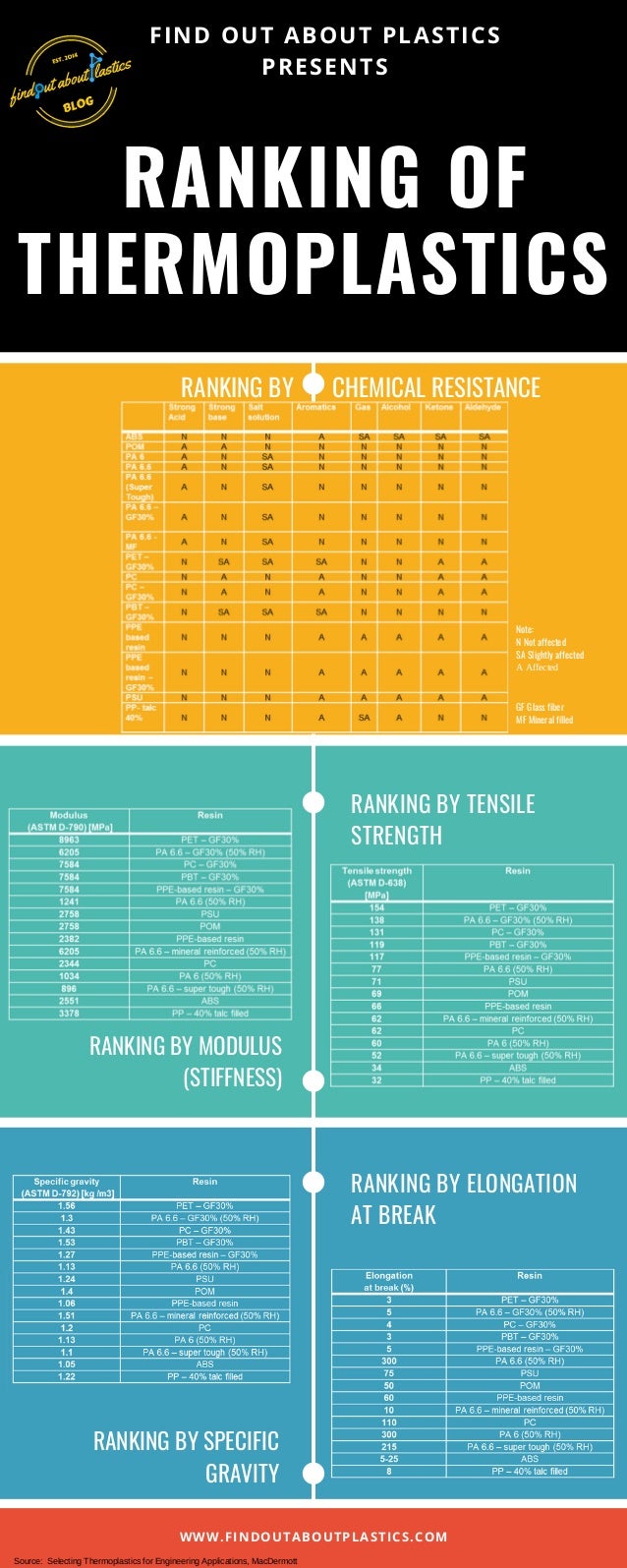
Ranking of Thermoplastics [Infographic]

Hello everyone to this post. Quick accessible knowledge about some properties of the most used engineering plastics can be key during the designing and material selection phase of your product. In this blog post I present to you an infographic which contains several tables providing design information.

Enjoy it and till next time!
Thank you for reading!

Herwig Juster
If you liked this post, share and like!
Interested in my monthly blog posts – then subscribe here.
New to my Find Out About Plastics Blog – check out the start here section.
Check out also my personal webpage.


Property Ranking of Thermoplastics - Updated Version (September 2021)