Sunday, 25 January 2015

What managers and executives can learn from Walt Disney

Most of us can remember the weekly appearing Mickey Mouse magazines. I am holding an actual issue in the picture on the left. Mickey Mouse and Walt Disney travelled together with us through our childhood. Walt Disney himself was a successful entrepreneur and one of the most creative people in history too. 

I would like to portrait successful people in the light of “What can we learn from them that improves our leading skills?”.

I found a little reportage about him and I would like to share the essential beliefs of Walt Disney.

So, here we go to my summary: 


Greetings,
Herwig R. Juster 

Wednesday, 24 December 2014

PET-Bottles: Before recycling - X-mas-cycle them

IMAG1833.jpg
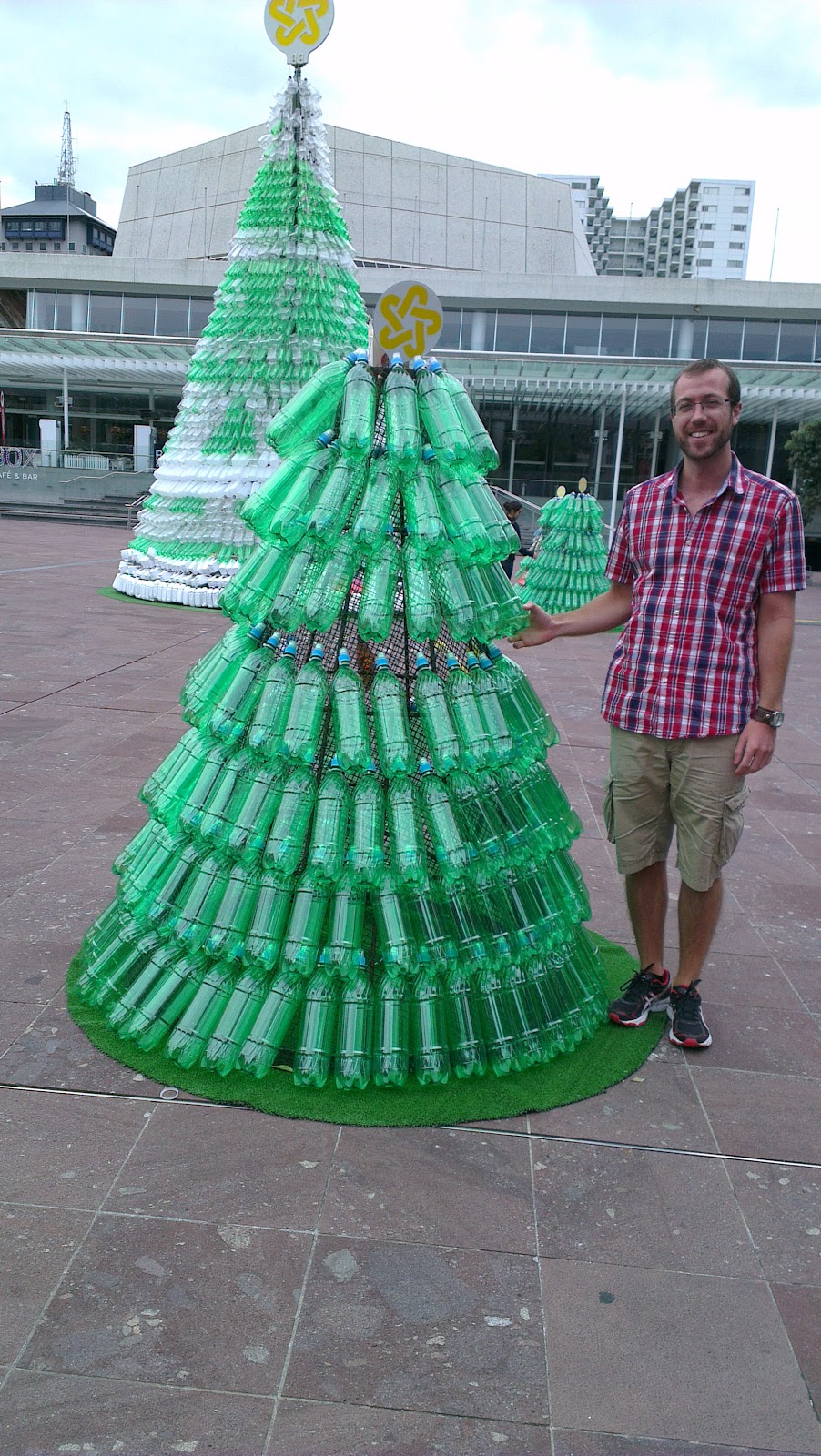
PET-Christmas tree in Auckland, New Zealand, 2013
Last year in December when I was visiting New Zealand we stopped by in Auckland. While crossing one of the squares, I immediately noticed from far away green and white triangles of different sizes standing there in a strange configuration. People in New Zealand were also in Christmas mood. These triangles were PET bottles of 0.5 up to 1.5 liters assembled creatively together to form multiple Christmas trees of different sizes and showing variable patterns.

This represents a way to show Christmas elements in a simple, creative and modern way. After the holidays, the bottles will be again collected and recycled to fibers for several applications.
So, when you like such applications and you have not yet a Christmas tree you can give it a try.


Other Christmas decorations involving polymers are for example polystyrene based Christmas stars: 
IMAG2531.jpg
PS-Granule Christmas star
Fill polystyrene granules in a backing shape and put them for 5 minutes in the oven. The granules will get soft and glue together. After they cool down, you can remove the shape and you will obtain a transparent star mimicking snow. You can also produce other shapes by the same method to decorate your house and/or Christmas tree.


I wish you a Merry Christmas and all the best for 2015!

Greetings
Herwig


Monday, 8 December 2014

Our plastics consumption - A view by polymer type, region and process


A polymer engineer friend of mine gave me a good suggestion for a topic for this blog:
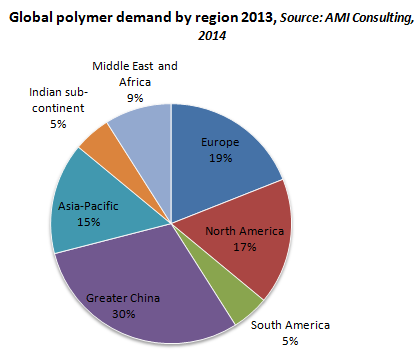
My colleague provided me the report of AMI Consulting 2014 and its data and facts from it that I will now share with you:

For you to get a feeling what the global polymer industry consumes on raw materials: It is worth more than US$ 500 billion per year. The industry subsequently transforms these into polymer based products which have a value of more than US $ 1 trillion. This is indeed a major driver of our world economy!

Everyone of you utilizes or at least touches in average 50 polymer based items per day.  Polymers provide these products the targeted performance and functionality.

But why are polymer products so successful?

Polymer based materials can be easily designed by chemically means as well as easily processed for particular ends. They can be made tough or flexible, hydrophobic or hydrophilic, and by processing they can take variable useful shapes that you may find all around your car, or your kitchen.
Therefore, the replacement of metals, glass and paper was inevitable.

Let’s have a look at the world demand grow: Since the year 1983 the demand grows from 45 million tonnes to an expected market demand of 250 million tonnes for 2014. Interesting is the shift of demand in a regional point of view. In 1983 areas like North America, Western Europe and Japan kept a share of world demand of 74%. Looking back to 2013, their world share decreased to 32% and countries like China and East Asia increased from 6% up to 29%. 

What about future trends?

A strong grow in demand is expected in the Indian sub continent. Why? The population there is bigger than in China but it has a polymer demand that is currently one-fifth of the size.

In Europe, the regions are expected to have the slowest growth rates. However, it has shown a constant market demand of 44-45 million tonnes for the past 3 years.

The market outlook for North America is better due to the availability of gas feedstock, which is necessary for producing polymers. It is predicted a cost reduction, especially for polyolefins. 

Which industry needs polymers the most?

AMI also had a look at the end-user applications of polymers: Although in many areas used, the field of packaging got dominant (50% of demand) and this in all parts of the world. It is followed by applications for construction (20% of demand). Applications like automotive, medical and electrical have a high attention, but in the volume they have a relatively small part.

According to a AMI calculations, there are over 230,000 plastics processing operations worldwide - this is an impressive number too!
And within the polymer processors one can find 130,000 injection moulding companies worldwide.

Greetings

Herwig R. Juster 


Friday, 21 November 2014

Carrot and stick approach: Still a proven concept in leadership!

Last month, during one of my officer-training seminars, I had a new experience regarding leadership behavior by training with horses.


What was the exercise?
Take a horse by its leash around a parcour and fulfill little tasks like walking forward and backwards together. It sounds like a simple task in theory but in reality it can develop challenging.


What is the background of it and why did we do this?


Horses are sensitive animals. They are shy and always prepared to run away. They mirror your leading behavior unfiltered and in a clear way back to you.  They are an instant feedback system. Let me give you an example: You want that your horse move forward. You give the command and even push the leash.


No movement at all!


Most people start now stroking the neck of the horse to make it more comfortable. This is not the way to do it. With such a behavior one actually promotes the action: "I did the right thing - I will not move!"

This means by not leading the horse in the right way, the wished behavior f.e. going backwards will not happen.

Depending on the age of the horse and thus its experience with humans, it starts questioning their leading. Horses see humans as animals with an alpha-status, but they still question this status at any time.


How are they testing you ? 
The horse tries to bite the leash: It tries to get control of the situation. It wants to find out whether you are really the boss or just a playmate.


What should you do to stay in control?
The right reaction is to straighten the leash and continue walking. Show the horse the way and it will follow your orders as well as it gains you respect.

Nowadays most of our leadership is focused on the strategic side of business: Decision making and figure out future market possibilities. The time we can spend on the "shop floor" is reduced and leadership decisions must be quick and accurate. Leaders have to stand in the front and understand their employees.

What were the lessons learnt:

1.      Most of the leading situations with employees are based on intuitive leading: Recognition of action and reaction of the employee in all kind of situations for achieving the aims. In addition, in terms of expressing your way and giving tasks to your team, a certain
level of energy is necessary. When you look like a potato bag, it is quiet hard to express, convince and communicate the tasks. And it is even harder for your team to trust you.

2.            You as a leader have to be willing to have the ability to assert your tasks. When you give up - it is easy for your employee to get control of the situation. And in the future it will be harder for you to regain respect from your employees.

3.           Take care of your non-verbal communication: The way you appear to the people is telling them if you are able to manage situations f.e. when you tell your employees that the situation is under control but your body shows stress symptoms like sweating and heavy breathing,  they will clearly see otherwise and they will be not willing to follow your lead. A simple advice: As a leader you have to stay relaxed!

By applying those lessons, your daily leading will be improved!

Greetings

H.R Juster