Tuesday, 25 February 2020

Creep Strength and Toughness of High Performance Plastics


In this blog post, we discuss the creep and toughness behavior of high performance plastics.

Creep – a general definition


In general, creep is the deformation of a material over a certain time under a constant load and constant environmental conditions. Estimation of creep properties is done by using the ISO standard 899-1 or the ASTM D2990. For testing, a defined force is applied onto a tensile bar over a certain period of time (e.g. 1000 hours) and temperature range. Temperature can vary between 23°C to 150°C.

As a plastics design engineer you are interested in such results when you are dealing with application parts which are under high load for a long period of time. Overall, environmental changes impact the creep behavior too. Especially the increase of the temperature decreases creep performance dramatically.

Creep strength of high performance polymers


In Figure 1, different unfilled high performance polymer grades are compared to each other at different temperatures. PAI and PBI show both excellent resistance toward creep. PEEK has good creep resistance at room temperature. However, the creep resistance at temperatures around 150°C decreases down to 8 MPa, since the glass transition temperature of PEEK is reached.
Figure 1: Tensile creep strength of different high performance plastics.
Adding fibers will increase the creep resistance. Carbon fiber filled PEEK will still not outperform unfilled PAI at 150°C in terms of creep resistance. For example, PEEK with 30% carbon fiber shows at 100°C a better creep performance as unfilled PAI. At 150°C, this turns around and PAI has the better creep resistance.


Toughness of high performance polymers


In general, toughness is the combination of polymer strength and ductility. Obtaining the toughness can be done over impact testing. A though polymeric material has a good ability to absorb energy during plastic deformation. There is a direct relation between the brittleness of a polymer and energy absorption.


There are two major tests for estimating impact values: Izod and Charpy test. Both can be done with notched and un-notched specimen. The load is applied at high rate and the absorbed energy is measured (Joule).


Figure 2 shows the maximal and minimal toughness values of high performance polymers. Among the amorphous high performance polymers, PolyPhenylenSulfone (PPSU) shows the highest energy absorption, whereelse PolyPhthalAmides (PPA) show high toughness values among the semi-crystalline high performance polymers.
Figure 2: Toughness values of different high performance polymers.
I hope you found this information useful and can support you in your next design decision with high performance plastics.
Thank you for reading!
Best regards, Herwig


If you liked this post, share and like!
Interested in my monthly blog posts – then subscribe here.
New to my Find Out About Plastics Blog – check out the start here section

Literature:
[1] Laurence W. McKeen: The effect of temperature and other factors on plastics and elastomers, 2008
[2] Omnexus.com

Saturday, 22 February 2020

Metal Replacement with Polyarylamide (PARA) for Single-Use Surgical Instruments


Today, we discuss an interesting evolving area: the metal replacement of single-use surgical instruments with high performance, semi-aromatic polyamides.

When you listen to the needs of hospitals and small ambulances all over the world, ready-to-use instruments which have optimal mechanical and ergonomic properties are high up on their wish list.

The non-active medical devices supplier Bastos Viegas from Portugal picked up this need in his hands and started a metal replacement program for stainless steel single-use surgical instruments.

The incumbent stainless steel solution fulfills all the mechanical requirements, however weight and cleaning procedures make them in the allover process of handling not attractive.

Requirements of plastic single-use instruments

To replace the stainless steel solution the polymer compound needs to fulfill the following requirements:
- High level of rigidity
- Dimensional stability
- Metal-like strength
- Biocompatibility according to ISO 10993
- Resistance to high-energy gamma radiation without significant change in appearance and physicochemical properties
- Resistance to ethylene oxide (EtO)
- Highly aesthetic surface finish


Material selection

Based on the list of requirements, different materials where analyzed. One material seemed quiet promising for Bastos Viegas from the beginning: the semi-aromatic Polyarylamide (PARA or MXD6).

This high performance polyamide brings all the aforementioned attributes under one roof. It has a metal-like strength (tensile modulus of 22 GPa at 50% glass loading, room temperature), high dimensional stability, half of the water uptake compared to a normal nylon 6.6. and has the best surface appearance among all polyamides (resin rich surface due to fine crystallization). In addition, its excellent flow ability (similar to PPS) and resistance to high-energy sterilization process made it the ideal candidate for such a replacement.

In the Figure 1 the properties of the selected Ixef® grade GS-1022 are compared to a standard nylon 6.6 and other engineering polymers.
Figure 1: Flexural properties of Polyarylamide (PARA) compared to other high performance and engineering plastics.


In Table 1, a comparison of different property values of PARA, Nylon 6.6, Nylon 6 and PBT is done. This comparison makes the advantages of PARA numerically visible: low water absorption in combination with high modulus values.


Table 1: Specific properties of Polyarylamide (PARA) and comparable others engineering plastics.

So far, we have compared PARA to other Nylon materials or other engineering plastics. Since we want to do a metal replacement, we are interest in the comparison of PARA with other metal die cast materials. This is shown in Table 2. As it can be seen, the tensile strength of PARA is at the same level or in some cases higher than that of the casting metals and its E-modulus although inferior is within the same range. As a result, required performance can be easily attained with significant reduced weight as looking at the respective densities of PARA and the metals.


Table 2: Specific properties of Polyarylamide (PARA) and different die casting metals.

Conclusion

The combination of different property data of PARA explains why PARA is such a good candidate for metal replacement. For instances, this is low moisture uptake, superior strength, stiffness, and highly aesthetic surface finish.

In the future, more and more medical metal applications will be replaced by high performance plastics such as PARA, PEEK and Polysulfones.

Below a selection of the different PARA-based Zillion Black® single-use instruments is shown.

Greetings and till next time,
Herwig Juster

If you liked this post, share and like!
Interested in my monthly blog posts – then subscribe here.
New to my Find Out About Plastics Blog – check out the start here section

Literature:
[1] https://www.solvay.com/en/press-release/solvays-ixef-para-enables-zillion-black-single-use-instruments
[2] https://www.solvay.com/en/brands/ixef-para

Tuesday, 28 January 2020

Microplastics: What Should We Know About Them and How Are They Impacting Our Life?


The environmental impact of plastics is an actual concern and a reoccurring topic in the media. In this context, the term microplastics is often referred to (Figure 1).

Google trend search on "Microplastics"

Figure 1: Google trend search “Microplastics” (2018-2019).


In this blog post, we approach microplastics in a general way:
-What is it?
-How can we define it?
-Where does it come from?


In addition, we look at some specific topics such as microplastics in humans, cosmetics, oceans and associated health concerns.


Microplastics definition


Mircoplastics are solid particles which are insoluble in water and were synthetically generated. We can distinguish between primary and secondary microplastic particles:


- Primary microplastics are all primary manufactured particles, i.e. (liquid) prepolymers, plastic pellets and powders;
- Secondary microplastics are fragments of larger plastic parts. For example, fragments of plastic bottles, bags and so on.


What are the sizes of microplastics?


In general, microplastics have a size smaller than 5mm. However, the term “microplastics” covers different sizes [1]:
- Milli range from 1-5 mm
- Micro range from 1-999 µm
- Nano range from 1-999 nm


Where do microplastics found in our environment come from?


There are seven major release sources of microplastics which contribute to environmental pollution, especially in our oceans.


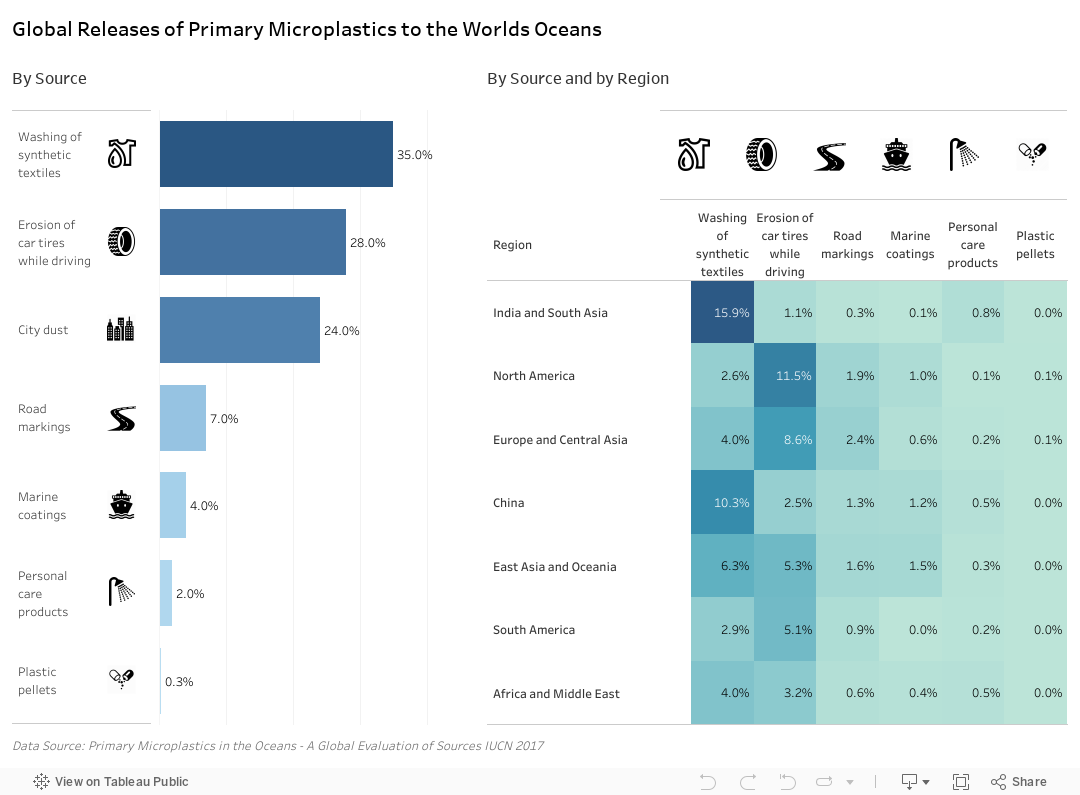
According to Figure 2, the major release source is the washing of synthetic clothes (35%). Microfibers of polyester and polyamide end up into the wastewater stream and then into the ocean. Main regions affected by this are India and South Asia. Following, are microplastics generated through wheel erosion during driving (28%). We have currently over 1 billion cars and the wheel debris is made up out of elastomeric particles. The third major generator of microplastics is city dust (24%). Smaller release sources are road markers (7%), marine coatings (4%), personal care products (2%) and plastic pellets (0.3%). The latter is mainly generated by resin manufacturers and/or resin processers.

Figure 2: Overview of major microplastic release sources [7].


Microplastics in humans


As shown before, we are all exposed to many sources of microplastics and interesting is now to understand their impact on our body.


Investigations have shown that we take up 2.000 microplastic particles when eating table salt. Altogether, it should be 32.000 particles which every one of us takes up per year [6]. The studied published by South Korean researches sampled salt from 21 countries all over the world, including Europe, North and South America, Africa, and Asia. The study found that the amount of microplastics varies strong among the different brands and regions. Asian brands contain much higher amounts of microplastics. Salt from Indonesia has the highest amount of microplastics and this region is known to have the second-worst level of plastic pollution in the world.


Comparing the different geographical sources of salt, microplastics levels were highest in sea salt, followed by lake salt and rock salt.
In 2018, the Medical University of Vienna, Austria found microplastic particles in the human feces of eight out of eight tested people. They tested five women and three men form different countries, the Netherlands, United Kingdom, Italy, Poland, Russia, Japan, and Austria. For one week, all people wrote down what they consumed daily and delivered a stool sample at the end of the week. Researchers found 20 microplastic particles per 10 grams stool. Nine different plastics could be identified in the size of 50 to 500 microns. Most materials found were PP (polypropylene) and PET (Polyethylenterephthalate) [3].


The World Health Organization (WHO) is looking intensely into the impact of microplastic in humans and started several investigations [5]. The concern of WHO is that microplastics can enter the human body over drinking water and harm body functions. However, this concern has so far no scientific back up. The report from WHO states that there is insufficient information to draw firm conclusions on the toxicity of microplastics. The investigations are still ongoing. Mr. Gordon, who is the WHO coordinator of water, sanitation and hygiene, stated that as a consumer who is drinking bottled or taped water you should not be necessarily concerned to be exposed to health risks.


My wrap-up on microplastics


In various areas in our life we are exposed to microplastics and studies have shown that PE and PP are the most found type of microplastics. In general, large Mw polymers such as polyolefins are harmless materials when eaten due to their macromolecule size. On the other hand, plastics usually contain additives (small molecules), which can be easily released out of the compound into the environment. For instances, due to human safety regulations, food and beverage packaging plastics comply with strict standards concerning allowed additives and respective amounts.


However, with city dust this is not the case. As described above, microplastic from rubber car wheels is a major cause of air pollution, together with car brake dust. In major cities, millions of cars impact in this way our air quality. People all around the world already realized that and work on concepts to change and improve it. Smart city concepts are on the raise. For instances, these enable transportation of multiple people by e.g. autonomous electric people movers, which have the potential to reduce allover amount of wheels in a city by reducing the allover amount of cars. Furthermore, braking in electric cars does not release brake dust due to regenerative braking (converting the kinetic energy for immediately use or storage in battery).


At the moment, it is difficult to avoid intake of microplastics and we will have them around since cars and clothes will not disappear. However, public awareness increased in the past years and organizations like the WHO and research organizations initiated several studies on their impact on our health. It is important to understand the cause-effect relationships in this context and find solutions which consider environmental, as well as economic-social aspects.


Thank you for reading and till next time!
Best regards,
Herwig Juster

If you liked this post, share and like!
Interested in my monthly blog posts – then subscribe here.
New to my Find Out About Plastics Blog – check out the start here section
Check out also my personal webpage.

Literature:
[1] H.A. Leslie: Review of Microplastics in Cosmetics, 2014
[2] https://www.addendum.org/plastik/besser-als-sein-ruf/
[3] https://www.meduniwien.ac.at/web/ueber-uns/news/detailseite/2018/news-im-oktober-2018/erstmals-mikroplastik-im-menschen-nachgewiesen/
[4] https://www.sciencehistory.org/case-study-plastics-and-the-human-body
[5] Susan Freinkel, Plastic: A Toxic Love Story (New York: Henry Holt, 2011), p. 89
[6] https://www.nationalgeographic.com/environment/2018/10/microplastics-found-90-percent-table-salt-sea-salt/
[7] https://phantomplastics.com/plastics-the-environment/

Sunday, 26 January 2020

High Performance Polymers: Suitable for Low Temperatures?


At this time of the year winter is all over our places and temperatures can get really frosty. In this post, we discuss the suitability of high performance polymers (polymers with continuous use temperature above 150°C) for lower temperature applications.


When writing down the requirements for your application during the material selection phase, most applications have a temperature range which needs to be fulfilled in order to ensure proper end use. In the automotive industry, for example internal combustion engines (ICE), have a temperature requirements ranging from -30°C to 140°C.


When screening the datasheet values of most plastics, room temperature properties such as mechanical, electrical and chemical properties indicate good resistance against environmental stress cracking. However, decreasing temperatures can lead to a brittle behavior with low values in failure stresses. Therefore, a material’s low temperature behavior also needs to be carefully taken into account during your material selection.


How to test the brittleness temperature of plastics and elastomers?


The brittleness temperature provides us information about the temperature at which brittle fracture is the dominant failure mechanism.


The test method ASTM D746-04 is usually utilized for measuring the brittleness temperature. The obtained temperature is usually found in the onset region of the glassy phase. It is rather difficult to obtain an exact temperature point. Accordingly, a brittleness temperature is estimated. This indicates a 50% probability of a brittle fracture to occur at this temperature.


ISO 974-2000 is another standard test method, which can be also be utilized. It is technically equivalent to ASTM D746-04 though. In case you want to test rubbers for impact brittleness, ASTM D 2137 is the preferred method.


Low temperature properties considerations


Application of rapid loads at room temperature can lead to the same effect of failure than having a higher load at lower temperature. This shows that apart of temperature, time and fatigue play an important role in the brittleness behavior of plastics.


Glassy vs. brittle


In general, polymers with a Tg above room temperature have a glassy state at room temperature. Examples are for instances PS, PMMA, and PET. These are easier to break since they are inherently more brittle. On the other hand, polymers which have a Tg below room temperature have a rubbery state at room temperature. These are, for example, PP and PE (LD, HD, LLDE), which are rather flexible and difficult to break at room temperature.


Fluoropolymers show a different behavior. PTFE has a Tg of 115°C. At room temperature as well as below room temperature one may think PTFE should be brittle. However, this is not the case due to its unique carbon-fluoro bond, which results also in a high melting point of 400°C. As a result, PTFE has good strength at higher as well as lower temperatures, below its Tg.


Service temperatures


The majority of applications have a service temperature range of -20°C up to 60°C and many commodity plastics are available to fulfill those ranges. There are low-temperature applications such as aircraft parts, oil rigs, industrial refrigeration, superconducting magnets, and liquid-helium devices, which are exposed to temperatures down to -270°C. Material selection becomes critical to prevent any part failure at such low service temperatures. At temperatures below -40°C, the choice for plastic materials becomes limited. In this temperature range, resistance to Liquid Oxygen (LOX) also becomes an extremely important application requirement.


LOX compatibility


Among different polymer families, high performance polymers such as fluoropolymers show good to excellent Liquid Oxygen compatibility. PTFE, FEP, and PCTFE show the best in class suitability, followed by PVDF. Altogether, fluoropolymers are good candidates for low temperature applications, since they are excellent insulators and have high chemical resistance.


Most important property of fluoropolymers at low temperatures is their ductility: when reaching the absolute zero temperature point (-269°C), the ductility of these polymers holds at approximately 1%. All in all, fluoropolymers are a good material choice for static seals at low temperatures.


Minimum service temperature of different high performance polymers


As we have already discussed, low temperatures are as challenging as high temperatures. This due to polymers showing brittle behavior, which can lead to fracture and crack formation in the final part. Besides fluoropolymers, other high performance polymers can be used at temperatures down to -50°C. For cryogenic temperature applications where high loads are involved, PAI and PI can also be used.


The graph below shows the minimum service temperature of different high performance polymers.

Summary
For most materials including plastics, low temperatures are a difficult environment. However, polymers such as PAI, PI and fluoropolymers can be a solution. In particular fluoropolymers, with their stable carbon-fluoro bonds, are suitable at extreme low temperatures. This in turn, supports designers to solve low temperature material problems in an efficient manner.


If you want to know more about fluoropolymers and why they are important in the future, you can find an article I wrote already here.


Thanks for reading & till next time!
Greetings

Herwig Juster


Interested to talk with me about your polymer material selection, sustainability, and part design needs - here you can contact me 

Interested in my monthly blog posts – then subscribe here and receive my high performance polymers knowledge matrix.

Literature:

[1] http://www.tangram.co.uk/TI-Polymer-Low_temperature_plastics.html