Showing posts with label biopolymers. Show all posts

Sunday, 14 December 2025

Practical Bio ABS Selection Guide Including Example (Housing of CHIMEI Ballpoint Pen)

Hello and welcome to a new blog post on selecting bio-based ABS materials for consumer applications. In the first section, I provide you with an overview on what to consider when selecting a bio-based material in general, and in the second section I discuss the housing of a ballpoint pen made out of bio-based ABS from CHIMEI.  

Selection of bio-based ABS plastic

When selecting a bio-based ABS plastic, consider its performance properties like impact resistance and temperature stability, its processability, and its end-of-life options, such as biodegradability or recyclability. You should also evaluate factors like cost, regulatory compliance (e.g., food contact), and sustainability claims using a method like a life cycle assessment (LCA) to ensure it meets your specific needs and environmental goals. 

Performance and functionality

  • Mechanical Properties: Compare the bio-based plastic's tensile strength, impact toughness, and ductility to conventional ABS to ensure it can withstand the application's stress.
  • Thermal Properties: Evaluate its operating temperature range, heat deflection temperature, and coefficient of thermal expansion (CTE) to prevent warping and ensure it's suitable for the intended environment.
  • Chemical Resistance: Determine if the bio-based plastic is resistant to the chemicals it will be exposed to. Some are sensitive to certain solvents, acids, or alkalis. 

Processability

  • Processing Methods: Check if the material is compatible with existing processing equipment, such as injection molding or 3D printing, and has a controllable melt behavior to reduce issues like warpage.
  • Additives: Be aware that additives, like silica, can affect properties. For instance, silica can improve strength but may increase brittleness.
  • Melt and Glass Transition Temperatures: Understand the material's specific temperatures for extrusion or printing, which will be different from fossil-based ABS. 

Sustainability and end-of-life

  • Bio-based content: Not all "bio-based" plastics are 100% derived from renewable sources. The bio-based content is an important metric, and certifications may require a minimum percentage to be considered eco-friendly.
  • Biodegradability: Bio-based does not automatically mean biodegradable. Verify if the material is compostable or biodegradable and what the specific requirements are for degradation.
  • Recyclability: Confirm if the material can be recycled and what infrastructure exists for recycling it.
  • Life Cycle Assessment (LCA): Use LCA to quantitatively compare the environmental impact of different bio-based options against each other and against traditional plastics across their full life cycle. 
  • End-of-life options: Bio-based does not mean biodegradable. Clarify the appropriate end-of-life pathway, which may include industrial recycling or composting, and ensure the necessary infrastructure exists in your region.
  • Sustainable sourcing: Investigate the sourcing of the bio-based feedstock to avoid competition with food and water resources or negative impacts on land use and biodiversity.
  • Supplier transparency: Work with suppliers and distributors that provide clear, detailed documentation on the formulation, sourcing, and environmental standards (like ISO 14001, REACH, or RoHS). 

Business and market considerations

  • Cost: Bio-based ABS is often more expensive than traditional ABS, though costs are expected to decrease as technology advances and production scales. Weigh the potentially higher material cost against the long-term value, including sustainability goals and customer demand.
  • Supplier reliability: Ensure the supplier can provide a consistent and reliable supply of material. Factors like agricultural yields and refining efficiencies can affect the availability and price of bio-based feedstocks.
  • Regulatory compliance: Confirm that the material meets all relevant regulations and standards for your application, such as FDA compliance for food contact or specific certifications for the automotive or electronics industries.
  • Consumer perception: Consider how your customers will perceive the new material. Use certifications and clear communication to market the product's environmental benefits accurately and transparently.

Industry example - CHIMEI Ecologue™ Bio ABS Material for Ballpoint Pen Housing

Wen-long Hsu (許文龍) founded CHIMEI Corporation, a Taiwanese company that became a leading producer of ABS (Acrylonitrile Butadiene Styrene) plastic, a versatile and durable material used in many products. Mr. Hsu was known for his business acumen and his commitment to social responsibility, which included prioritizing the welfare of his employees and funding the creation of the CHIMEI Museum. The history of CHIMEI ABS is therefore the story of a successful business built by Mr. Hsu Wen-long on a foundation of ethical business practices and a vision for social contribution. 

At K Fair 2025 I was introduced to Mr. Yu-Ching Yang, Director of Sales Division from CHIMEI and he gave me a special gift: a ballpoint pen made out of bio-based ABS (Figure 1). 

What makes it so special? 

Figure 1: Ballpoint pen housing made out of Ecologue™ Bio ABS.

It is made out of their Ecologue™ Bio ABS. Instead of fossil based feedstock, Ecologue™ Bio ABS uses bio-attributed feedstock, allowing for product carbon footprint (PCF) reduction of 122% compared to fossil based ABS (Figure 2). Such an impressive reduction is achieved by using biomass residues or wastes as the feedstock and enhancing circularity.

Figure 2: Emission comparison of fossil-based ABS vs. CHIMEI bio-based ABS.

Key Takeaways for Selecting Bio-Based ABS Plastics

Performance Must Match Application Needs:
When considering bio-based ABS, ensure its mechanical, thermal, and chemical properties are suitable for your specific application. Not all bio-based alternatives perform identically to conventional ABS, so thorough testing and comparison are essential.

Sustainability Claims Require Scrutiny:
“Bio-based” does not always mean biodegradable or fully renewable. Always verify the actual bio-based content, recyclability, and end-of-life options. Use tools like Life Cycle Assessment (LCA) to objectively evaluate environmental impact and ensure the chosen material aligns with your sustainability goals.

Business and Compliance Factors Matter:
Evaluate the cost, supplier reliability, and regulatory compliance of bio-based ABS. Transparent documentation and certifications are crucial for both market acceptance and meeting industry standards.
All over, keep a holistic approach—balancing performance, sustainability, and business needs—when selecting bio-based ABS plastics next time.

Thank you for reading & #findoutaboutplastics
Greetings, 
Herwig 

Literature: 
[1] https://www.chimeicorp.com/en-US?page=article&id=641137a3909e10048d14afca
[2] https://salesplastics.com/abs-plastic/#:~:text=ABS%20maintains%20stability%20across%20a,and%20thermal%20degradation%20during%20processing.


Sunday, 14 May 2023

Pumping Plastics 2022 - My New Book "Pumping Plastics" is Now Available as Paperback Worldwide on Amazon!


Pumping Plastics 2022 by Herwig Juster


Dear community, 

welcome to this special book update! 

Pumping Plastics is the name of my new book and it contains all the blog posts of 2022.

For instances, this include topics such as :

-Sustainability in the plastics industry

-Guest interviews with innovative material start-ups

-Polymer design properties and multi-point design data

-Plastics additives (three part series)

The book can be read chronologically from month to month, but not necessarily.You can also directly jump to the post(s) of your interest.

As a bonus, the first chapter of my first book "Polymer Material Selection" is included.

I invite you all to have a look and grab a copy.

Tuesday, 15 March 2022

Engineering Biopolymers - Using the 3P-Triangle to Select Them

Hello and welcome to a new post. Today I show you how you can use the 3P (price, performance, and processing)-triangle to select engineering biopolymers.

An overall summary on bio-based polymers can be found in this three part bio-based polyamide series.

Motivation of Engineering Biopolymer Usage

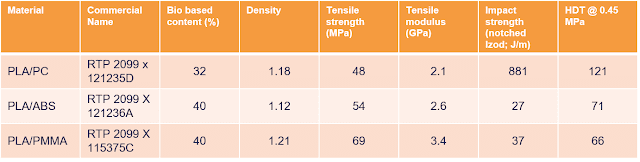
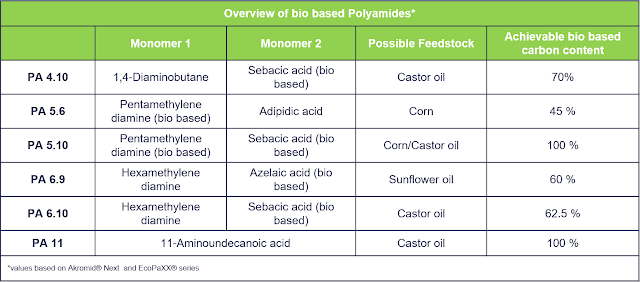
Engineering polymers represent much lower volumes compared to commodity plastics and bio-derived engineering polymers represent a niche within this engineering plastics segment. Packaging materials are much more visible to consumers on a daily basis compared to for example under the hood automotive applications. Therefore, research focus was more directed towards replacing high volume single use polymers with recycled and bio-based materials solutions. However, consumer perspective is shifting towards all different polymer applications to have recycled content or be bio-based. In addition, more and more OEMs demand recycling and bio-based content in their plastic parts. Material suppliers work on drop-in bio-based solutions for traditional polymer applications. One way are hybrid materials out of a 100% bio based polymer blended with a traditional engineering polymer such as PC (Table 1). Often biopolymers show a brittle behaviour. Blending a bio-copolyester such as Polybutylene adipate terephthalate (PBAT) with a Polylactic acid (PLA) will result in a ductile (derived from PBAT) and stiff (derived from PLA) material. Polyamides are among the most used engineering polymers and there are already several short- and long chain bio-based Polyamides available, where one or both monomers are derived from bio sources (Table 2).

Table 1: hybrid materials out of a 100% bio based polymer blended with a traditional engineering polymer

Table 2: overview bio-based Polyamides

Material Selection – Visual approach using the 3P-triangle

The price, processing and performance triangle allows to compare similar plastics and how well they measure up against each other in a visual way. Incorporation of environmental sustainability values is done over “processing” where the nature of feedstock is included and over “performance” which takes the materials impact during use-life and recycling phase.

With bio-based engineering polymers, the balance between fulfillment of rigorous property requirements of the target application and life-cycle impact need to be found during material selection. I developed three steps to achieve such a balance.  

1. Step: We define the maximum allowed environmental impact of the material which can be provided by the customer (numerical value – example: GWP)

2. Step: Incorporate this value into the semi-quantitative polymer comparison triangle together with price, processing and performance.

3. Compare different polymers to each other and make a decision which to investigate further

Example: injection / blow moulded water bottle

In the following, an example helps to better understand the 3P-triangle approach. For an injection moulded water bottle, the incumbent material is most of the times PET and can be placed more towards the price vertex due to its low costs. As a next alternative, bio-based PET can be used  which improves towards the processing vertex. PLA, on the other hand will improve processing, however will increase material costs. This may change in the future too, due to more availability of bio-based materials. Altogether, the 3P-triangle is a tool which can be put into your polymer material selection tool box and supports selecting bio-based polymers.

I made also a short training video on this topic: 


Thanks for reading and #findoutaboutplastics

Greetings

Literature: 

[1] Plastics and Sustainability: Towards a Peaceful Coexistence between Bio-based and Fossil Fuel-based Plastics, Michael Tolinski


Tuesday, 8 March 2022

Bio-Based Polyamides – Part 3: Sustainability Facets (Bio Sourcing, LCA, Certifications) and Example Polyamide 6.10

 Hello and welcome to part 3 of our bio-based Polyamide series. 

Check out part 1: PA 5.6 and 5T (Chemical Structure, Production, Properties, Applications, Value Proposition) here and part 2: Short and Long Chain Aliphatic Polyamides (PA 6, PA 11, PA 6.10, PA 10.10) here

In this post, I focus on three topics under the sustainability umbrella: bio sourcing, LCA, and certifications

Bio sourcing for polyamides

Materials based partially or complete on renewable biomass fall into this definition. Castor beans, trees, and crops are major examples of this category. Fossil based or biomass based materials have all carbon atoms in their back. This allows a distinction of bio-based polyamides in terms of their bio content. For functional groups and inorganic groups, this is not possible and a mass-based approach is used.

ASTM D6866 and EN 16640 are used for the determination of bio-based carbon content in polyamides and other polymers. Base working principle is the radiocarbon analysis which allows to determine the carbon fraction (C14 measurement) [1].

Life Cycle Assessments

Life Cycle Assessments (LCAs) are used to identify the environmental impact of a certain material or produced good thorough their life cycle and currently two major standards are used for LCAs: ISO 14040:2006 (Environmental management — Life cycle assessment — Principles and framework) and ISO 14044:2006 (Environmental management — Life cycle assessment — Requirements and guidelines).

The structure of a LCA contains a scope section and the impact categories. Within the scope section distinctions between three variations is done: gate-to-gate, cradle-to-gate, and cradle-to-grave. For polymers the preferred scope is cradle-to-gate and this scope covers all processes as well as environmental impacts (buying feedstock and making the polymer). Often high performance bio-polyamides are tailored to the specific customer requirements by compounding selected additives into the base polymer. End-of-life disposal is more complex and harder to access for the polymer manufacturer. Environmental impact can be estimated using following metrics:

-greenhouse gas emissions,

-ozone depletion,

-human toxicity (cancer effects),

-human toxicity (non-cancer effects),

-photochemical ozone formation,

-ionizing radiation, particulate matter,

-terrestrial acidification,

-terrestrial eutrophication,

-marine eutrophication,

-ecosystem toxicity,

-resource depletion (fossil),

-resource depletion (abiotic),

- and water resource depletion.

For customers and polymer manufacturers, the global warming potential (GWP expressed over CO2 equivalent) is the most interesting value as well as the most frequently requested value within the LCA report.

Example Polyamide 6.10

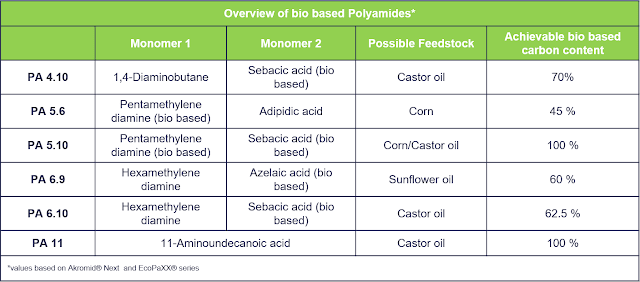
Manufacturing of a long chain Polyamide PA 6.10 is made as shown in Table 1 by sebacic acid (C10H18O4) and HMDA (C6H16N2). For bio-based Polyamide 6.10, the sebacic acid is bio-sourced. In general, bio-sourced products have a lower carbon footprint since they contain locked atmospheric (biogenic) carbon in the product. In case of combustion or degradation of sebacic acid (based on castor oil) at the end-of-life, this would result in approximately 1.5 kg of CO2 equivalent release. The whole Polyamide 6.10 would lead to a release of 2.2 kg of CO2 equivalent. The total carbon footprint (from raw material, polycondensation of Polyamide minus the biogenic carbon of sebacic acid) of Polyamide 6.10 is 4.6 kg Co2/kg. In case Polyamide 6.10 is made 100% out of petrochemicals, the carbon footprint would be 7.3 kg CO2/kg. The aforementioned 2.2 kg of CO2 equivalent are most probably released before 100 years since end-of-life is reached before 100 years (GWP calculations use a 100 year time frame).

Table 1: overview of bio based Polyamides

Certifications

As already mentioned under the section “Bio-sourcing”, radiocarbon dating is a good method to distinguish between fossil based carbon and bio based carbon. The C14 isotopes for fossil based material display a different set compared to bio based ones. Standard is DIN ISO 10694. Other certifications are ISCC PLUS and REDcert². Both are leading sustainability certification systems for bio-based and recycled materials. Certifications and proper labeling get more and more important since the end customers are demanding such distinctions more and more.

What are some trends in 2022?

We see more and more the use of recycled plant based oils and fats to produce Polyamides which reach a carbon footprint of only 0.5 kg Co2/kg [2]. Also, 100% bio-based carbon content is possible with Polyamides. PA 11 uses only 11-aminoundecanoic acid which can be won from castor oil. This enables a 100% bio-based carbon content. Also PA 5.10 can be produced in a 100% bio based carbon way using pentamethylene diamine and sebacic acid out of corn and castor oil.

Thanks for reading and #findoutaboutplastics

Greetings, 

Herwig 


Literature: 

[1] https://www.findoutaboutplastics.com/2021/07/biopolymers-difference-between-bio.html

[2] https://akro-plastic.com/compound-overview/akromid-next/

[3] Stephan Kabasci: Bio-Based Plastics: Materials and Applications


Tuesday, 15 February 2022

Design Data for Plastics Engineering: Selected Properties of Natural Fiber Based Polymer Compounds

Hello and welcome to a new blog post. Today I present to you selected properties of natural fiber based polymer compounds as part of our design data for plastic engineering series.

Which natural fibers can be used and why to replace e-glass with them?

The use of natural fibers represents a sustainable alternative to synthetic glass and carbon fibers. They can be used in applications ranging from automotive, aeronautics to building and construction. Natural fibers can be plant, animal, and mineral based. In this post, we focus only on plant based fibers as reinforcement. The most important plant based fibers (cellulose) include cotton, flax, hemp, jute, pineapple, abaca, wood, wheat, rice, bamboo, and esparto. Among the animal fibers are lamb’s wool, goat hair, angora wool, and cashmere. Mineral fibers are fibrous brucite and wollastonite.

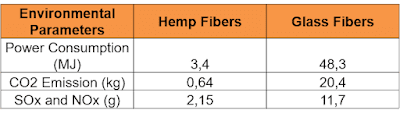
Recycling of glass and carbon fibers is still high energy consuming. Table 1 shows the environmental parameters (production of 1 kg of fibers [5]) of hemp and glass fibers. In all three categories, hemp fibers represent a sustainable alternative to glass fibers.

Table 1: environmental parameters (production of 1 kg of fibers [5]) of hemp and glass fibers

Properties of fibers

Before deciding to replace glass fibers with natural fibers, a look at the mechanical properties of natural fibers is important. This will later enable a better material formulation and material selection.

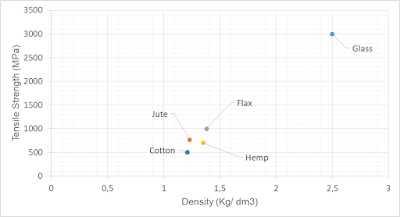
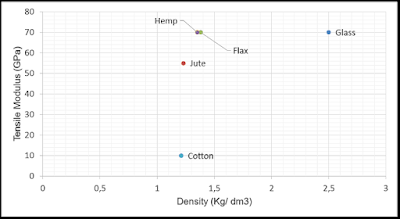
Figure 1 and 2 compares the mechanical properties of glass with those of jute, flax, hemp, and cotton. It can be shown that the tensile modulus of flex and hamp is with 70 GPa in the range of the glass tensile modulus.

Figure 1: Tensile strength vs. density of different natural fibers and glass fiber

Figure 2: Tensile modulus vs. density of different natural fibers and glass fiber


Properties of natural fiber reinforced plastics

For formulating plastic compounds using natural fibers, thermal processing properties must be in the suitable range of the fibers. Polyethylene (PE) and Polypropylene (PP) base polymers are good examples for such a suitability and our examples will be based on a PP copolymer.

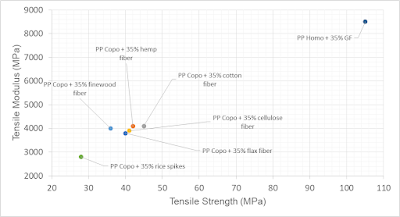
Figure 3 presents the mechanical properties of PP based natural fiber compounds (six different fibers; always 35%) and compares them to a PP based glass fiber compound (also 35%). Within the natural fiber compounds, mechanical values are in a similar range. PP glass fiber reinforced compounds are double in tensile modulus and tensile strength.

Figure 3: Tensile modulus vs. tensile strength of different PP compounds with natural fiber reinforcement and PP with glass fiber reinforcement


Conclusions

Natural fiber based compounds allow a weight saving in the range of 10 -30%. Most used fibers are hemp, jute, and flax. Hemp fiber production is almost pesticide free. Additionally, hemp fibers are hydrophilic and proper drying must be done prior to compounding. In terms of performance, natural fiber compounds can be used in automotive interior applications (door panels, seat backs paneling), together with exterior applications (bumpers, spoilers). In building and construction, such compounds can be found in roof panels and insulations.

Thanks for reading and #findoutaboutplastics

Herwig Juster


🔎Join my inner circle (monthly newsletter)out Plastics Blog – check out the start here section

Literature:

[1] WIS Polymer-Wissenmatrix; https://www.advanced-compounding.com/de/polywood-pp.html

[2] https://www.researchgate.net/figure/Mechanical-Properties-of-chemically-treated-jute-fibre-reinforced-polymer-composites_tbl6_282073854

[3] https://www.frontiersin.org/articles/10.3389/fmats.2019.00226/full#B95

[4] https://hal.archives-ouvertes.fr/hal-03153829/document

[5] Shahzad, 2011: https://journals.sagepub.com/doi/10.1177/0021998311413623


Monday, 11 October 2021

Bio-Based Polyamides – Part 2: Short and Long Chain Aliphatic Polyamides (PA 6, PA 11, PA 6.10, PA 10.10)

Hello and welcome back to our bio-based polyamide blog series. In part 1 we discussed the bio-based PA 5.6 and today in part 2 we discuss bio-based homopolyamides (short and long chain) as well as long chain copolyamides (polyalkylene sebacamides).

Homopolyamides from Biomass Derived Monomers

There are two commercially feasible ways in making biomass based Polyamide 6 (Figure 1): the first route is over sugar and the second route uses starch as a starting point. In the second route an additional processing step is needed (hydrolysis of starch to obtain Glucose). For obtaining a long chain homopolyamide (PA 11), five processing steps are involved and 93% more biomass is needed to obtain 1 metric ton of Polyamide. AS a starting point for Bio-PA 11, caster beans are used.

Figure 1: Routes for making Bio-PA6 and Bio-PA 11


Copolyamides from Biomass Derived Monomers

For obtaining a long chain biomass based copolyamide we need a diamine which reacts with a diacid and either both (fully bio-based) or just one (partially bio-based) is derived from biomass. In Figure 2, the reaction routes of Bio-PA 6.10 and Bio-PA 10.10 are shown.

Figure 2: Routes for making Bio-PA 6.10 and Bio-PA 10.10


Selected properties of bio-based polyamides

In Table 1, typical properties of petroleum-based and bio-based polyamides are shown. The functional amide group which facilitates an internal hydrogen bond between the polymer chains, leads to properties such as hardness, good impact strength and excellent abrasion resistance. Comparing short chain to long chain aliphatic polyamides, the short chain outperforms the long chain in terms of thermal and mechanical properties. However, the long chain aliphatic polyamides have a higher chemical resistance as well as hydrolysis resistance together with low water uptake. Bio-based Polyamides cover the short chain and long chain spectra and depending on the application case, they can outperform or underperform petrol-based Polyamides. The properties shown in Table 1 are the base polymer properties and in most cases the base polymer will be modified with glass fibers and additives. This in turn will make direct comparisons more difficult and more data must be considered in the polymer material selectionprocess (long term data, cyclic data, and chemical data).  

Table 1: Selected properties of petrol- and bio-based Polyamides

Processing and Applications

Injection moulding polyamides represents around 76% of the total polyamide consumption and the automotive and truck market is here in the lead in terms of annual consumption. Other important markets are consumer articles, electrical and electronic parts and appliances parts. Extrusion represents 23% of the total polyamide consumption and covers applications in the field of wire and cable, tubing and piping, and non textile filaments. The remaining 1 % represents powder coating applications.

Bio-based Polyamides start to capture applications in the automotive field, especially for Electric Vehicles. However, due to the current price level and capacities, Automotive will not be the dominating applications field. Long chain bio-based Polyamides offer different properties compared to the more price sensitive short chain Polyamides. Blending and co-polycondensation with petrol based Polyamides will allow to reach the ideal price-to-performance ratio faster. Ongoing regulations to reach certain CO2 levels and Global Warming Potentials (GWP) allows bio-based Polyamides to faster capture applications in different industry sectors. Also, customer demand for such solutions is increasing as well as the regulations.

Thank you for reading and #findoutaboutplastics

Greetings

Herwig Juster

#materialselection #polymerengineering #biobased #biopolyamides

Interested to talk with me about your plastic selection and part design needs - here you can contact me 

Interested in my monthly blog posts – then subscribe here and receive my high performance polymers knowledge matrix.
New to my Find Out About Plastics Blog – check out the start here section

Literature:

[1] https://polymerdatabase.com/Polymer%20Brands/Biopolyamides.html

[2] https://matmatch.com/learn/material/biopolymers?utm_content=175746192&utm_medium=social&utm_source=linkedin&hss_channel=lcp-21389968

[3] https://www.ifbb-hannover.de/files/IfBB/downloads/faltblaetter_broschueren/Biopolymers-Facts-Statistics-2018.pdf

[4] Bio-Based Plastics Materials and Applications, S. Kabasci;

Tuesday, 28 September 2021

Bio-Based Polyamides – Part 1: PA 5.6 and 5T (Chemical Structure, Production, Properties, Applications, Value Proposition)

Hello and welcome to this three part series on bio-based polyamides. Since biopolymers are among the fastest growing segment in the polymer industry it is worth having a closer look at selected new polymers, such as the PA 5.6. In the first part we will discuss some definitions and then turn the focus towards Polyamide 5.6 and 5T. In part two we have a look at bio-based PA 6.6 and in the third part onto bio-based high performance polyamides.

Definitions and some basics

In this training video I review the chemistry of Polyamide 6 and Polyamide 6.6, discuss the properties and applications of Polyamides and look at their global demand and producers.

In general, Polyamides are semi-crystalline condensation polymers with repeating amide (–CO–NH–) links in their backbone. The number after the prefix ‘PA’ results from the number of carbon atoms between the amide groups. Furthermore, there are Monadic (AB) and Dyadic (AABB) Polyamides. AB-Polyamides have a single repeating lactam with an amine reactive group and as a ‘B’ component a carboxylic acid group. AABB-Polyamides are created by the reaction of diamine and a diacid. For them, the first number after the prefix ‘PA’ is the diamine and the second number describes the diacid. Now back to our bio-based Polyamides

Chemical structure and production of bio-based PA 5.6

Pentamethylene diamine, which is needed for PA 5.6, can be made from biomass or sugar. This is enabled by using microorganisms and in 2013 the company Cathay Industrial Biotech was able to increase the efficiency of amino acid decarboxylase by 100 times during the biological fermentation processes. As an enabler, a gene engineering technique was applied. This can be considered as the breakthrough for industrial up-scale of bio-sourced pentamethylene diamine (commercial name: C-BIO N5). Condensation reaction of the green diamine with a diacid (petrol based or bio-sourced) will lead to a full or partially bio-sourced Polyamide 5.6 (commercial name: Terryl™), depending if the diacid is bio-based too. Cathay claims that 8% less diamine is needed with C-Bio N5.

Cathay and Toray too hold patents on Polyamide PA5T. In general, the melt temperature of 5T is lower compared to PA6T and glass transition temperature of 5T is 141°C and therefore slightly higher (Tg 6T = 138 °C) which results in an improved thermal stability. Due to the high amide group concentration of PA 5.6 and PA5T, water absorption is higher compared to PA6T and PA 6.6.

Properties of PA 5.6 compared to PA 6.6 and PA 6

In the table below major thermal and mechanical properties of PA 5.6, in comparison to PA 6 and PA 6.6 are shown. The comparison indicates that PA 5.6 is more similar to PA 6.6 than to PA6.

Table 1: Property Comparison of Petrol-Based vs. Bio-Based Polyamides

Processing and applications

Processing of bio-based PA 5.6 can be done via the melt fiber spinning route for yarns and textiles as well as injection moulding for engineering parts. Since some internal H and O sites are free (compared to PA 6.6 where all internal H and O sites are bound), an easier dyeing is achieved. Furthermore, the higher moisture absorbance increased the comfort of wearing. Injection moulding compounds reinforced with glass fiber, enter different industries such as automotive, electrical, and industrial.

Environment, Health, Safety and Value Proposition

The bio organism fermentation approach described in the first section represents a safer route to produce monomers and polymers due to lower temperature, low pressure and much less toxic raw materials as well as by-products. This in turn makes the whole process more environmentally friendly, reduces the carbon footprint and also energy requirements. The value proposition of bio-based plastics in general is that by switching the monomer sourcing base from petrol to bio-based plant feedstock an  material with intrinsically zero carbon footprint is obtained. The obtained polymers are not necessarily biodegradable and the optimal end-of-life option (for example circular economy approach) needs to be further developed. 

Also, PA5X (X=6, 10, 12, 13, 16, 18) and PA56T are all already commercially available for global market applications which allows them to be the tomorrow's choice to cover sustainable, renewable and environmental demands.

In this post I discuss the difference between bio-based content vs. bio-based carbon content and in this post helpful standards for composting of biodegradable polymers. In the second part we discuss bio-based Polyamide 6.6 – stay tuned!

Thank you for reading and #findoutaboutplastics

Greetings

Herwig

#materialselection #polymerengineering #biobased

Interested to talk with me about your plastic selection and part design needs - here you can contact me 

Interested in my monthly blog posts – then subscribe here and receive my high performance polymers knowledge matrix.
New to my Find Out About Plastics Blog – check out the start here section

Literature:

[1] Bio-Based Plastics Materials and Applications, S. Kabasci;

[2] TERRYL™ bio-based nylon, P. Caswell, Cathay Industrial Biotech

[3] Progress in semi crystalline heat-resistant polyamides, C. Zhang

[4] https://matmatch.com/learn/material/biopolymers?utm_content=175746192&utm_medium=social&utm_source=linkedin&hss_channel=lcp-21389968

[5] https://matmatch.com/learn/property/difference-between-biodegradable-compostable-and-degradable?utm_content=176494659&utm_medium=social&utm_source=linkedin&hss_channel=lcp-21389968

Sunday, 8 August 2021

Composting Biodegradable Polymers – Helpful Standards

Hello and welcome to this blog post on biodegradable plastics and their related standards. In one of my last blog posts we discussed the difference between the standards EN16785-1 (bio-based content) and ASTM D6866/EN 16640 (bio-based carbon content). Today we have a closer look at ASTM D6868, ASTM D 6400, EN 13 432, ISO 17 088 and what it means for composting biodegradable polymers.

In general, biopolymers can be biodegradable or non-biodegradable as well as made from renewable sources or from fossil-based resources. This is shown in Figure 1 below.

Figure 1: Overview classification of biopolymers [1].

Standards for composting of biodegradable polymers

Apart from the estimation of the bio content, clarification of compostability after usage of the product is the next key topic for biodegradable plastics.

In Table 1, the most important ASTM / EN standards are shown to help you guide through the jungle of standards.

For example, ASTM D6868 standard is used for labeling of products that consist out of biodegradable plastics and polymers together with paper and other carriers intended for aerobically composition in municipal or industrial facilities. The products also include packaging applications. Performance of the materials in terms of compostability or biodegradability is not covered by this standard, only labelling.

Table 1: standards for composting of biodegradable polymers.

Update: ISO 17088 has been revised in 2012 and more recently in 2021.

Thanks for reading and #findoutaboutplastics

Greetings,

Herwig

#biopolymers #herwigjuster

 Interested to talk with me about your plastic selection and part design needs - here you can contact me 

Interested in my monthly blog posts – then subscribe here and receive my high performance polymers knowledge matrix.
New to my Find Out About Plastics Blog – check out the start here section

Literature:

[1] https://bpiworld.org/page-190424

[2] https://www.astm.org/Standards/D6868.htm

[3] https://bpiworld.org/page-190422

[4] https://docs.european-bioplastics.org/publications/bp/EUBP_BP_En_13432.pdf

[5] https://www.iso.org/standard/43373.html


Monday, 19 July 2021

Biopolymers – Difference Between Bio-Based Content vs. Bio-Based Carbon Content

Hello and welcome to a new post. With the arrival of new legislation to better protect the environment in Europe and other parts of the world, polymer manufacturers are extending their portfolio on bio-based polymers. In this post we investigate the question of what exactly the bio-content means of biopolymers.

In general, a bio-based product is made from biomass (plants, trees, algae, marine organisms, microorganisms) and there are two different concepts used in the plastics industry:

1.    Bio-based content: refers to the amount of biomass in a product; it considers four key elements: carbon, hydrogen, oxygen and nitrogen; expressed as percentage of overall weight of product;

2.    Bio-based carbon content: focus is on the carbon; expressed as percentage of the carbon the product contains;  

Most of the bio-based polyamide polymers use monomers from the sebacic acid chain which in turn is derived from non-food competing castor oil.

EN 16785-1 – bio-based content                 

Determination of the bio-based content is done over the EN 16785-1 standard which includes the measurement of the bio-based carbon (C14).

ASTM D6866 and EN 16640 – bio-based carbon content

For determination of the bio-based carbon content of polymers, ASTM D6866 standard was established with the working principle of radiocarbon analysis. With this method, determination of the carbon fraction including the bio-based percentage therein (C14 measurement) is done.

Illustrating the difference with an example

We want to access the bio content of a PLA (plant-origin, containing 50% carbon) and polypropylene (fossil-origin, containing 86% carbon) which are blended in a ratio of 30/70%. According to EN 16785-1, the bio-based content of this composition is in total 30%, whereas according to ASTM D6866 and EN 16640, the bio-based carbon content is 20% (Figure 1).

Figure 1: Difference between bio-based content (EN 16785-1) and bio-based carbon content (ASTM 6866 / EN 16640) estimation for biopolymers


I hope that this post helped to better understand bio-polymers and how to read the amount of bio content. 

Thanks for reading and #findoutaboutplastics

Herwig Juster

#biopolymers #herwigjuster

Interested to talk with me about your plastic selection and part design needs - here you can contact me 

Interested in my monthly blog posts – then subscribe here and receive my high performance polymers knowledge matrix.
New to my Find Out About Plastics Blog – check out the start here section


Literature: 
[1] T. Garrison et.al. Bio-Based Polymers with Potential for Biodegradability, Polymers, 2016
[2] TÜV - Information Document 536 (EN) – 19.10